

How to Manifest Through Writing: Four Writing Exercises With Research Behind Them, and How to Use Them
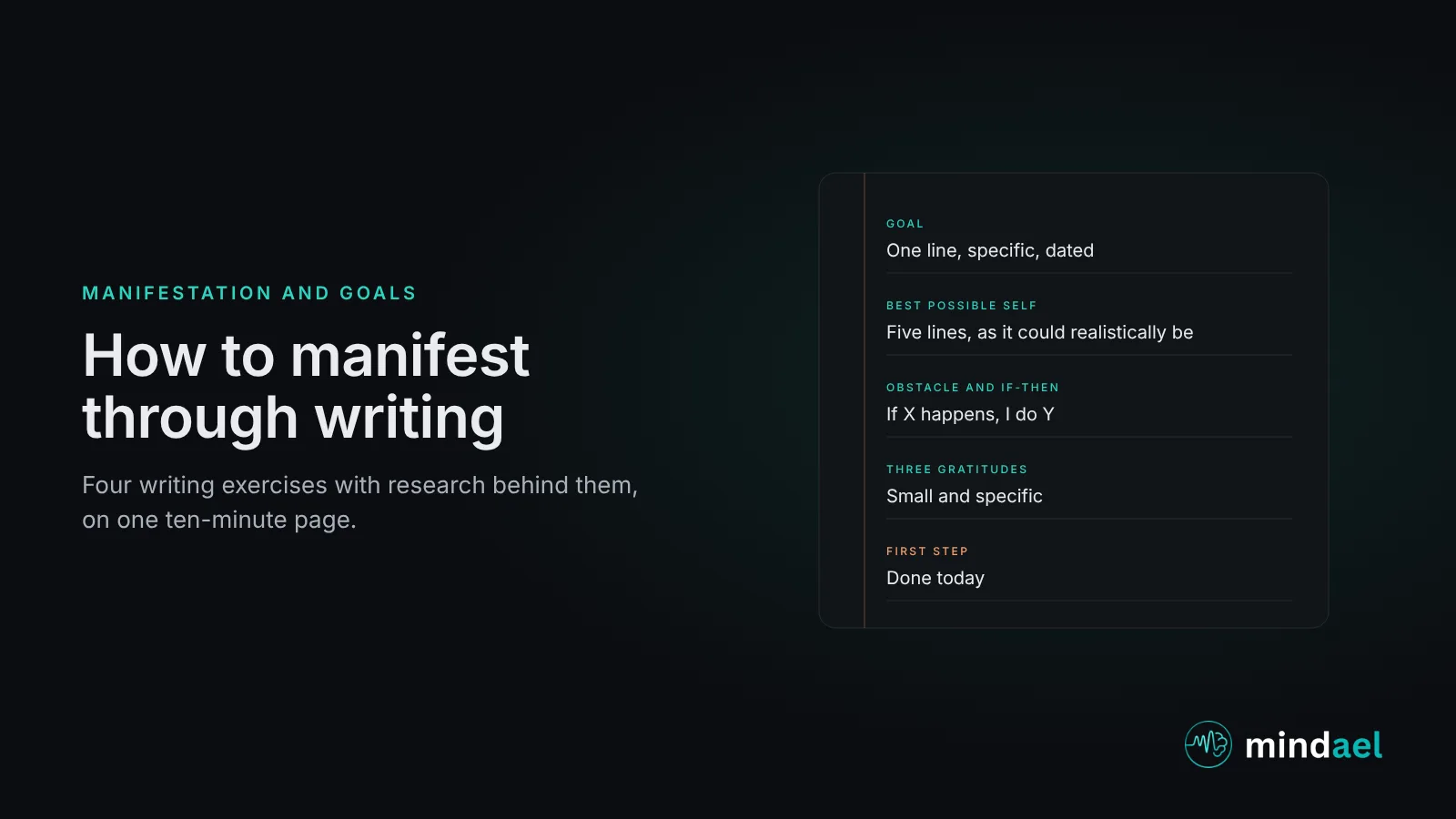
Writing does not make the universe deliver what you want, and no study shows that it does. But four writing exercises that people use for manifesting have real research behind them for what they actually do. Writing about your best possible future self for a few minutes a day raised optimism over two weeks in a randomised study. Writing the obstacle and an if-then plan for it made people noticeably more likely to follow through across many studies, while picturing only the dream lowered the energy to act. Writing down things you are grateful for each week lifted mood. And writing openly about what worries or hurts you was linked with better mental and physical health in a body of studies. Use them as a ten-minute morning page: one goal, the best possible self, the obstacle and plan, three gratitudes, then the first step.
How to manifest through writing is one of the most searched manifesting questions, and the honest answer has two halves. Writing will not make the universe deliver what you want; no study shows it does. But some of the writing exercises people use for manifesting have been tested, and they do real things: more optimism, clearer plans, better follow-through and a lighter mood. This article covers four of them and puts them on one page. We make Mindael, a sound app many people use for quiet morning minutes, free to download on the App Store.
1. The best possible self
Imagine that everything has gone as well as it realistically could: you worked hard and reached your goals. Write about that future for five minutes, in detail. In a randomised study, people who imagined and wrote about their best possible self daily for two weeks became more optimistic than a control group, and the effect held beyond a simple change in mood (Meevissen et al., 2011).
This is the part that feels most like manifesting. It is also the part that needs the next step.
2. The obstacle and the plan
Picturing only the dream has a cost: in experiments, people who fantasised about an ideal outcome felt less energised afterwards (Kappes and Oettingen, 2011). So after the best possible self, write the main obstacle, the one inside you, and an if-then plan for it: “If it is 6 p.m. and I have not sent the email, I send it as it is.” Across many studies, plans like this made people noticeably more likely to reach their goals (Gollwitzer and Sheeran, 2006). Our how to manifest something guide walks through this step by step.
3. Three specific gratitudes
Write three things from the last day you are grateful for, specific and small: “the walk at lunch”, not “my health”. In randomised studies, people who regularly listed things they were grateful for reported better mood than people who listed hassles or neutral events (Emmons and McCullough, 2003).
4. Worry writing, when you need it
Some mornings, the goal is buried under worry. Then write about the worry itself, openly, for ten to fifteen minutes, without editing. In a body of studies, writing about emotional experiences was linked with better mental and physical health (Pennebaker, 1997). Then close the notebook and come back to the goal tomorrow.
The ten-minute page
Same time each morning, same quiet sound, such as rain or the 6 Hz theta beat:
- One goal, specific and dated, at the top.
- Best possible self, five lines.
- The obstacle and the if-then plan, two lines.
- Three gratitudes.
- The first step, done today.
If you prefer a fixed format, the 369 method and scripting are explained in our manifesting on paper article. Our manifestation guide has the full morning practice.
The short version
Writing does not attract events. It makes you clearer, more optimistic and more likely to act. Write the best possible self, then the obstacle and the plan, then three gratitudes, and use worry writing on heavy days. Ten minutes, the same time and sound each morning, and the first step the same day. For a quiet sound to write with, Mindael is free to download on the App Store.
Ten quiet minutes, one page.
Mindael has rain and a stream recorded without loops, the 6 Hz theta beat and studio-made tones such as 528 Hz, two at a time, for the same quiet minutes each morning. Free to download, no account, works offline. The sound is the cue; the page is the work.
- Rain, stream, theta beat and studio-made tones
- Two sounds at once, the same sound every morning
- Free to download, no account, works offline
 Free · No account needed · Works offline
Frequently asked questions
Does manifesting through writing work?
Writing does not attract events, and no study shows it does. What writing does is make you clearer, more optimistic and more likely to act. Writing about a best possible self raised optimism, and writing an if-then plan for an obstacle made people noticeably more likely to reach their goals.
What should I write to manifest something?
One specific goal, a few lines about your best possible future self when it is achieved, the main obstacle inside you, an if-then plan for it, and three specific things you are grateful for. Then do the first step the same day.
What is best possible self writing?
An exercise where you imagine that everything has gone as well as it realistically could, and write about that future for a few minutes. In a two-week randomised study, people who did it daily became more optimistic than a control group.
Is scripting the same as manifesting through writing?
Scripting is one form: writing in the present tense as if the wish has already come true. It can feel good, but writing only about the finished dream can lower the energy to act. Add the obstacle and the plan to make it useful.
How long should I write each day?
Five to ten minutes is enough. The studies used short sessions: a few minutes of best possible self writing, a weekly gratitude list, or about fifteen to twenty minutes for writing about difficult feelings.
What if writing about my goals makes me anxious?
Write about the worry itself first, openly, for ten to fifteen minutes, then close the notebook. If low mood or anxiety is behind the wish for change, a doctor or therapist is the right next step.
Sources
- Meevissen YMC, Peters ML, Alberts HJEM. Become more optimistic by imagining a best possible self: effects of a two week intervention. Journal of Behavior Therapy and Experimental Psychiatry, 2011.
- Gollwitzer PM, Sheeran P. Implementation intentions and goal achievement: a meta-analysis of effects and processes. Advances in Experimental Social Psychology, 2006.
- Kappes HB, Oettingen G. Positive fantasies about idealized futures sap energy. Journal of Experimental Social Psychology, 2011.
- Emmons RA, McCullough ME. Counting blessings versus burdens: an experimental investigation of gratitude and subjective well-being in daily life. Journal of Personality and Social Psychology, 2003.
- Pennebaker JW. Writing about emotional experiences as a therapeutic process. Psychological Science, 1997.
This article is for general information and is not medical, financial or psychological advice. Writing is a planning and reflection tool; it does not change events outside your actions. If low mood, anxiety or hopelessness is behind the wish for a change, a doctor or therapist is the right next step.
This article is part of our manifestation and the law of attraction guide. Hear the sounds in this article in the Mindael sound library, or see our app comparison checklists.