

How to Manifest Something: A Step-by-Step Method for One Specific Goal, What the Research Supports, and What to Leave Out
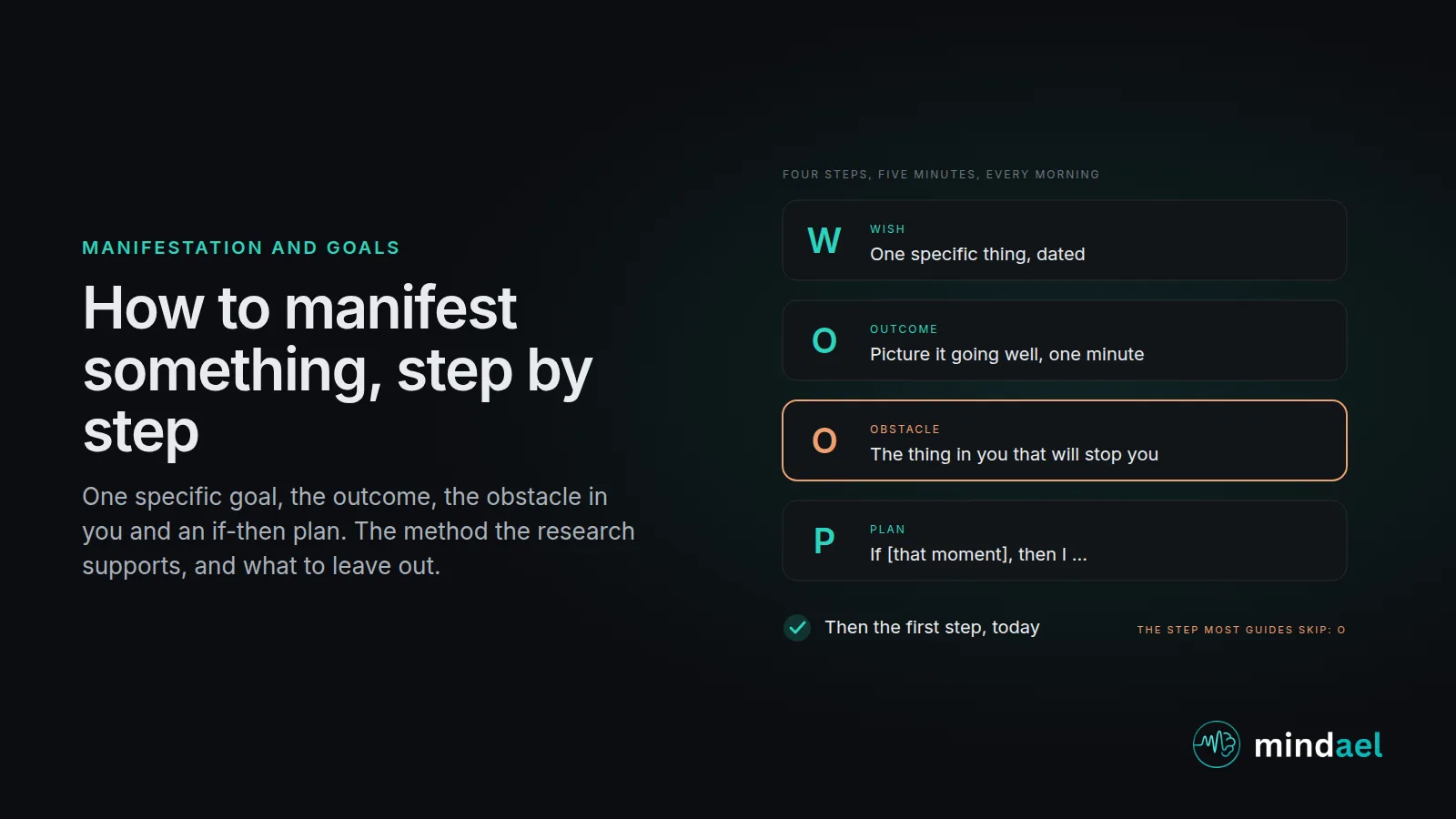
To manifest something, in the sense that gets results, you pick one specific thing, picture the best outcome briefly, then picture the obstacle inside you most likely to stop you, and write an if-then plan for it. Psychologists call this mental contrasting with implementation intentions, or WOOP: wish, outcome, obstacle, plan. It outperforms positive thinking alone in study after study, because picturing only the outcome lowers the energy to pursue it. Add a first step you can take today, a weekly review and the same short practice at the same time each day. What does not help: waiting for a sign, repeating that you already have it, or treating a setback as proof you did not believe enough. Nothing in this sends a signal to the universe; the method works through what you do next.
How to manifest something is a question with two kinds of answer. One says believe hard enough and the universe will arrange it. The other, from forty years of research on goals, says something less romantic and much more reliable: picture the outcome briefly, then picture what in you will get in the way, and plan for that. This article gives the second answer as a step-by-step method for one specific goal, explains why the obstacle step matters most, and lists what to leave out. The sound many of our listeners run it to is in Mindael, free to download on the App Store, and the wider picture, what the law of attraction claims and what the research supports, is in our law of attraction guide.
The short answer first
Nothing you think sends a signal that arranges events; there is no evidence for that and no mechanism, and we will not pretend otherwise. What thinking about a goal can do is change what you do next, and the research is precise about which kinds of thinking help. Picturing only the finished result feels good and measurably lowers the energy to pursue it (Kappes and Oettingen, 2011). Picturing the outcome and then the obstacle, and planning for the obstacle, does the opposite. That is the method.
Step 1: Pick one thing, and make it specific
One goal, not five. Specific, not vague: “an offer from a design studio by March”, not “a better job”; “save 3,000 by June”, not “more money”, and our manifesting money article applies the method to money in detail; “run 5 km without stopping by 1 December”, not “get fit”. Hard and specific goals produce better performance than “do your best” goals across hundreds of studies, because a specific goal tells you what the next step is and when you are done (Locke and Latham, 2002). If you cannot name the next step, the goal is not specific enough yet.
Step 2: Picture the best outcome, briefly
Close your eyes for a minute and picture the outcome going well: what it looks like, how it feels. This is the part the popular versions of manifesting stop at, and it is worth doing, because it connects the goal to something you actually want. Keep it to a minute. Longer, and the pleasant picture starts to stand in for the real thing.
Step 3: Picture the obstacle, the one in you
Now the step most guides skip. Ask what inside you is most likely to stop you: not the economy or other people, but the habit, the feeling, the moment. “I get home tired and open the phone.” “I avoid sending the email because I am afraid of a no.” Picture it as concretely as you pictured the outcome. Gabriele Oettingen’s research group calls this mental contrasting, and across many studies it turned wishes people could realistically reach into stronger commitment and more action, while wishes that were not realistic got let go of instead, which is also useful (Oettingen, 2012).
Step 4: Write the plan as if-then
One sentence: “If [the obstacle moment], then I [specific action].” “If I get home and reach for the phone, then I put it on the shelf and open the laptop for fifteen minutes.” “If I hesitate before sending, then I send it within a minute and close the tab.” Across 94 studies, adding an if-then plan like this to a goal had a medium-to-large effect on whether people followed through (Gollwitzer and Sheeran, 2006). Together, steps 2 to 4 are the method the research calls WOOP: wish, outcome, obstacle, plan.
Step 5: Take the first step today
Not tomorrow, and not after a sign. The smallest real action: one email, one list of studios, one ten-minute run. Picturing the process of getting there, the next week of steps as they will go, helps more than picturing the prize; students who rehearsed how they would study started earlier and scored higher than students who pictured the grade (Pham and Taylor, 1999).
Step 6: Repeat it, same time, same sound
Five minutes each morning, the four steps again, before the phone. The same sound each time, rain low on a speaker or the 6 Hz theta beat in earbuds, so that sitting down with it becomes the habit rather than a decision. Daily repetition at a fixed cue became automatic after a median of 66 days in the one real-world study that measured it, and missed days did little harm (Lally et al., 2010). Once a week, look at what happened: what worked, what the real obstacle turned out to be, and rewrite the plan. If you prefer to do the steps on paper, our manifesting on paper article turns them into a five-line page.
What to leave out
“Act as if you already have it.” Repeating that something is already true, when part of you knows it is not, invites an internal argument; for people with low self-esteem, positive self-statements made things worse in a 2009 study. Picture the outcome; do not insist on it.
Waiting for a sign. Signs are what the brain finds when it is looking for them. The step is the sign.
Long visualisations of the finish line. They are the specific thing the research found lowers energy. A minute is enough.
Blaming yourself for not believing enough. A setback is information about the plan, not a verdict on your faith. Rewrite the if-then and go again.
The 24-hour and 17-second promises. You can decide something in seventeen seconds, and deciding is real. The outcome takes as long as its steps.
When the goal is calm rather than a project
Some people come to manifesting wanting a feeling rather than an outcome: less anxiety, more ease, a sense that things are going to be all right. For that, the method above is the wrong tool and a practice is the right one. Our how to start meditation article is a ten-minute beginning, the meditation sounds guide goes further, and the morning guide covers the first hour of the day, where both practices fit.
The short version
Pick one specific thing. Picture the best outcome for a minute. Picture the obstacle in you. Write “if, then” for it. Take the first step today. Repeat for five minutes each morning to the same sound, and review weekly. That is how to manifest something in the only sense the evidence supports: by making it much more likely that you do what gets it.

Five minutes, one sound, one step.
Mindael has rain, ocean and a stream recorded without loops and the 6 Hz theta beat made in our studio, with a timer that fades at the end of the five minutes. Free to download, no account, works offline. Press play, run the four steps, then take the first one.
- Rain, ocean, stream and the 6 Hz theta beat, studio-made
- Two sounds at once, a timer that fades
- Free to download, no account, works offline
 Free · No account needed · Works offline
Frequently asked questions
How do you manifest something?
Choose one specific thing. Picture the best outcome for a minute. Then picture the main obstacle in you that is most likely to get in the way, and write an if-then plan for it: 'if it is 8 p.m. and I have not started, then I open the file and write one paragraph.' Take the first step today and review weekly. That sequence, called WOOP in the research, outperforms positive visualisation alone.
Can you manifest something specific?
Specific is easier, not harder, because a specific goal tells you what the next step is. 'A job I like' gives you nothing to do this afternoon; 'an offer from a design studio in Lisbon by March' gives you a list of studios. What specificity cannot do is make an outcome happen that depends on things outside your actions, and no method can.
How long does it take to manifest something?
As long as the steps take. The practice becomes a habit in about two months of daily repetition, on average, and the goal itself takes whatever its steps take. Methods that promise 24 hours or 17 seconds are describing a feeling, not an outcome.
Can you manifest something overnight?
You can decide something overnight, and deciding clearly is a real first step. The outcome still depends on the steps. If something does arrive overnight, it was already on its way through things you or others did; the method's job is to make more of those things happen on purpose.
What is the WOOP method?
Wish, outcome, obstacle, plan: a five-minute exercise developed by psychologist Gabriele Oettingen from twenty years of research on positive thinking. You name a wish, picture the best outcome, then picture the inner obstacle, then make an if-then plan to get past it. Trials found it improved exercise, diet, study and relationship goals compared with picturing the outcome alone.
What should you not do when manifesting?
Do not picture only the finished result, which lowers the energy to act. Do not repeat 'I already have it', which invites an argument you lose if you doubt it. Do not wait for a sign before acting. And do not read a setback as a failure of belief; it is information about the plan.
Sources
- Oettingen G. Future thought and behaviour change. European Review of Social Psychology, 2012.
- Kappes HB, Oettingen G. Positive fantasies about idealized futures sap energy. Journal of Experimental Social Psychology, 2011.
- Gollwitzer PM, Sheeran P. Implementation intentions and goal achievement: a meta-analysis of effects and processes. Advances in Experimental Social Psychology, 2006.
- Locke EA, Latham GP. Building a practically useful theory of goal setting and task motivation: a 35-year odyssey. American Psychologist, 2002.
- Pham LB, Taylor SE. From thought to action: effects of process- versus outcome-based mental simulations on performance. Personality and Social Psychology Bulletin, 1999.
- Lally P, et al. How are habits formed: modelling habit formation in the real world. European Journal of Social Psychology, 2010.
This article is for general information and is not medical, financial or psychological advice. Goal-setting methods change what you do, not events outside your actions. If a goal is tied up with low mood, anxiety or a crisis, please talk to a doctor or therapist.
This article is part of our manifestation and the law of attraction guide. Hear the sounds in this article in the Mindael sound library, or see our app comparison checklists.