
Manifesting Money: What the Popular Methods Get Wrong, What the Research on Goals and Saving Supports, and a Plan That Actually Moves It
Manifesting money, in the popular sense, means affirmations ('money flows to me'), visualising wealth, scripting a richer life, or listening to a 'money frequency'. None of these has evidence behind it, and two of them, picturing the finished result and affirmations that you do not believe, are known to lower the energy to act. What does move money is ordinary and well studied: a specific number with a date, a picture of the obstacle as well as the goal, an if-then plan for the moment you usually slip, and automatic rules that remove the decision, such as saving a share of each future raise. This article explains each popular method honestly, then gives a short plan built from what works. Nothing here is financial advice.
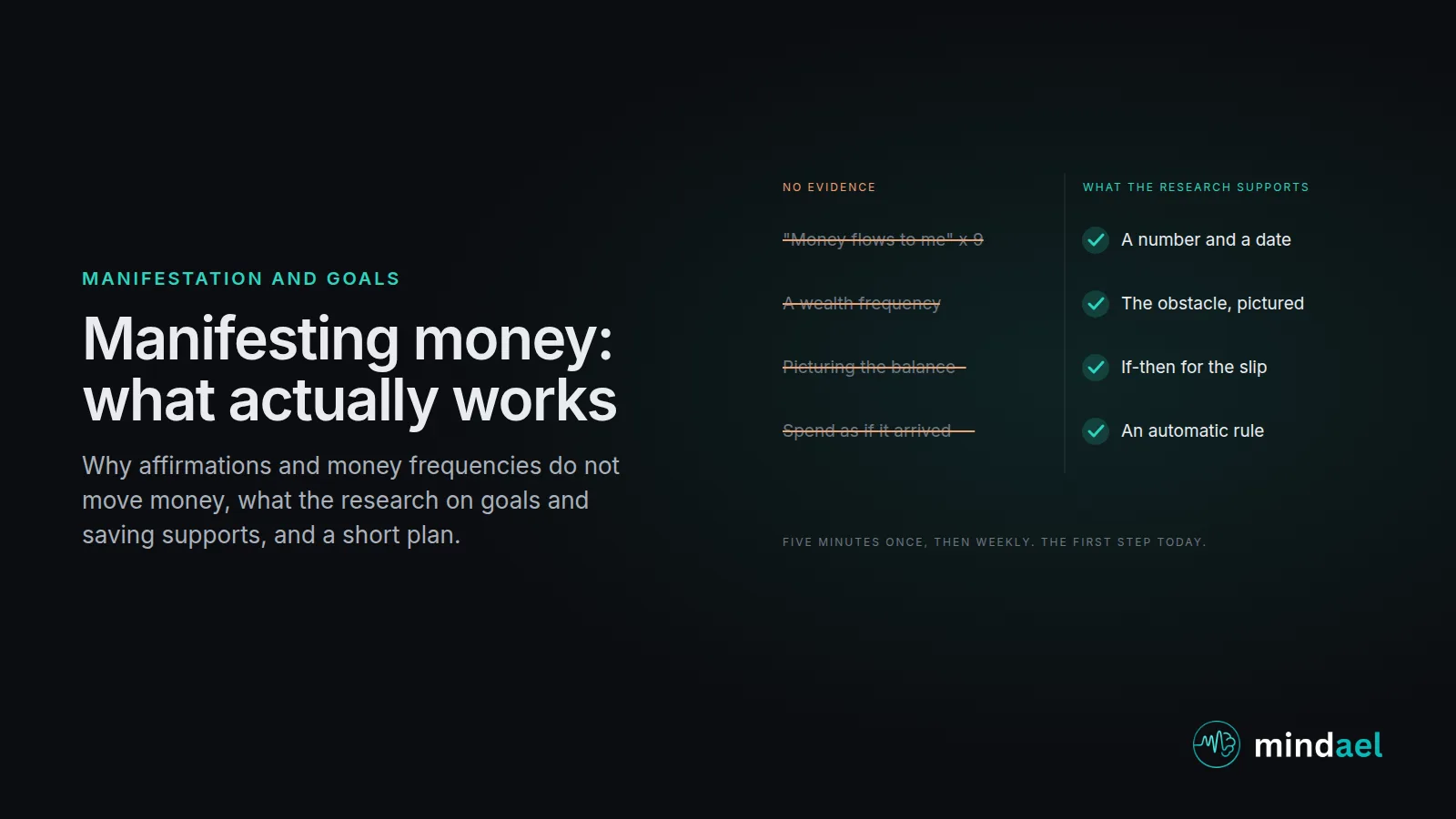
Manifesting money is the most searched corner of the law of attraction, and the one where the gap between the promise and the evidence costs the most. The popular methods ask you to feel rich, repeat that money flows to you, picture the bank balance, or play a “money frequency” while you sleep. This article goes through each honestly, says what the research on goals and saving actually supports, and ends with a short plan that moves money for ordinary reasons. The sound many of our listeners plan to is in Mindael, free to download on the App Store, and the wider picture is in our law of attraction guide. Nothing here is financial advice.
The popular methods, honestly
Money affirmations. “Money flows to me easily.” There is no evidence that repeating a sentence changes income, and for the people most likely to try it, the evidence points the wrong way: positive self-statements lifted mood slightly in people with high self-esteem and made people with low self-esteem feel worse, because the sentence starts an argument they lose (Wood et al., 2009).
Visualising wealth. Picturing the house, the balance, the relief. It feels good, which is the problem: across four studies, positive fantasies about an idealised future lowered the energy people had to pursue it, measured both in self-report and in blood pressure (Kappes and Oettingen, 2011).
Scripting a rich life. Writing pages in the present tense as if you are already wealthy. The same result applies; our manifesting on paper article covers scripting and the 369 method in detail, and how to turn the page into something useful.
Money frequencies. 888 Hz, 528 Hz and “wealth” tracks on video sites. No study, no mechanism. A tone cannot change what you earn. A steady sound can help you sit still for five minutes and think, which is worth something, and that is all we claim for it; our best frequency for healing article explains what the tones have actually been tested for.
“Feel like you already have it.” Spending or borrowing as if money has arrived is the one method on this list that can actively hurt.
What the research supports
A specific number and a date. “Save 3,000 by 1 June” outperforms “be better with money” for the same reason specific goals outperform vague ones everywhere: they tell you what to do next and when you are done (Locke and Latham, 2002).
The outcome, then the obstacle. Picture the result for a minute, then picture the thing in you most likely to derail it: the payday spend, the subscription you never cancel, the email you avoid. Mental contrasting like this turned realistic wishes into stronger commitment and more action across many studies (Oettingen, 2012).
An if-then plan for the moment you slip. “If I open the shopping app after 10 p.m., then I close it and add the item to a list for Saturday.” Adding a plan like this to a goal had a medium-to-large effect on follow-through across 94 studies (Gollwitzer and Sheeran, 2006).
Automatic rules that remove the decision. The most successful saving programme in the behavioural economics literature asked employees to commit in advance to saving a share of future pay rises; average saving rates among participants rose from 3.5 to 13.6 percent over about four years, largely because the decision only had to be made once (Thaler and Benartzi, 2004). A standing transfer on payday is the personal version.
A plan that moves money
Five minutes, once, then once a week. The same sound each time, rain low or the 6 Hz theta beat in earbuds, so the weekly check-in becomes a habit rather than a decision.
- The number. One amount, one date, written down. Earn, save or pay off: one at a time.
- The outcome, one minute. What it looks like when it is done.
- The obstacle. The moment in your week when this usually goes wrong.
- The if-then. One sentence for that moment.
- The automatic rule. A standing transfer on payday, a percentage of the next raise, a round-up, a cancelled subscription. Something that runs without you.
- The first step, today. Send the invoice, list the thing to sell, ask for the review, open the account, make the call.
Once a week, look at what moved and rewrite the if-then for whatever got in the way. The step-by-step version of this method for any goal is in our how to manifest something article.
What to keep from manifesting
The hope, the focus and the daily attention are real, and they are the parts that help. People who think about their goal every day and expect it to be reachable are more likely to act on it. The parts to drop are the ones that ask you to feel finished before you start, to argue with yourself in the mirror, or to wait. And if money worries are keeping you up at night, that deserves attention in its own right: our anxiety guide has a short routine for the spike, and the sleep sounds guide the night-time setup.
The short version
Affirmations, wealth visualisation, scripting and money frequencies have no evidence behind them, and two of them lower the energy to act. A specific number with a date, the obstacle pictured alongside the outcome, an if-then plan and an automatic rule are what the research supports. Five minutes once, then weekly, and the first step today. That is manifesting money in the only sense that moves it.
Five quiet minutes, then the step.
Mindael has rain, ocean and a stream recorded without loops and the 6 Hz theta beat made in our studio, with a timer that fades at the end of the five minutes. Free to download, no account, works offline. Sit with the number, the obstacle and the plan, then make the first move.
- Rain, ocean, stream and the 6 Hz theta beat, studio-made
- Two sounds at once, a timer that fades
- Free to download, no account, works offline
 Free · No account needed · Works offline
Frequently asked questions
How do you manifest money?
In the sense that works: choose a specific amount and date, picture the outcome briefly and then the obstacle in you most likely to get in the way, write an if-then plan for that moment, take one concrete step today, and set up an automatic rule so the habit runs without willpower. Affirmations, money frequencies and visualising wealth do not move money and can lower the energy to act.
Do money affirmations work?
There is no evidence that they change your finances. For people who do not believe them, positive self-statements made mood worse in a 2009 study, because they set off an internal argument. If you like a daily sentence, make it a plan rather than a claim: 'when I get paid, I move 10 percent before I spend anything.'
Is there a frequency for attracting money?
No. Tones sold as 'money frequencies' or 'wealth frequencies', often 888 Hz or 528 Hz, have no study behind them and no mechanism by which a sound could change income. A steady sound can help you sit still and plan for five minutes, which is useful, but the plan does the work.
How can I manifest money fast?
Nothing reliable is fast. What is fast is the first step: listing what you can sell, sending the invoice, asking for the overdue payment, applying for the job. Those happen today if you plan the moment; the result follows at its own speed.
What is the 369 method for money?
Writing a money affirmation three times in the morning, six in the afternoon and nine at night. The numbers are folklore. As a habit it is a reminder at three fixed times, which can help if the sentence is a plan; repeating that money is coming does nothing beyond that.
Can manifesting money be harmful?
It can be if it replaces action or invites risk: waiting for money instead of earning or saving it, spending as if it has already arrived, or treating a gamble as 'aligned'. And believing you failed because you doubted is unkind and untrue. Keep the hopeful part and attach it to a plan.
Sources
- Kappes HB, Oettingen G. Positive fantasies about idealized futures sap energy. Journal of Experimental Social Psychology, 2011.
- Wood JV, Perunovic WQE, Lee JW. Positive self-statements: power for some, peril for others. Psychological Science, 2009.
- Gollwitzer PM, Sheeran P. Implementation intentions and goal achievement: a meta-analysis of effects and processes. Advances in Experimental Social Psychology, 2006.
- Oettingen G. Future thought and behaviour change. European Review of Social Psychology, 2012.
- Thaler RH, Benartzi S. Save More Tomorrow: using behavioral economics to increase employee saving. Journal of Political Economy, 2004.
- Locke EA, Latham GP. Building a practically useful theory of goal setting and task motivation: a 35-year odyssey. American Psychologist, 2002.
This article is for general information and is not financial, legal or psychological advice. Goal-setting methods change what you do, not events outside your actions. For decisions about debt, investing or tax, please talk to a qualified adviser, and if money worries are affecting your sleep or mood, a doctor or counsellor can help.
This article is part of our manifestation and the law of attraction guide. Hear the sounds in this article in the Mindael sound library, or see our app comparison checklists.