

A Manual for Manifesting Your Dream Life: Seven Chapters, From the Big Picture to This Week
A dream life is not one wish but many parts of a life moving at once, so manifesting it works best as a system rather than a single ritual. This manual has seven chapters: map the main areas of your life and score each one; write a short, vivid picture of the life you want a year from now; choose just one area to work on for the next 90 days; name the obstacle inside you that is most likely to stop you; turn it into if-then plans; review every week; and rest the picture between reviews. Research supports the core steps. Dreaming alone can backfire: in experiments, positive fantasies about an ideal future lowered people's energy to act. Pairing the dream with the obstacle and an if-then plan helped people reach goals across 21 studies, and if-then plans on their own had a medium-to-large effect across 94 tests. Nothing here promises an outcome; it makes action more likely.
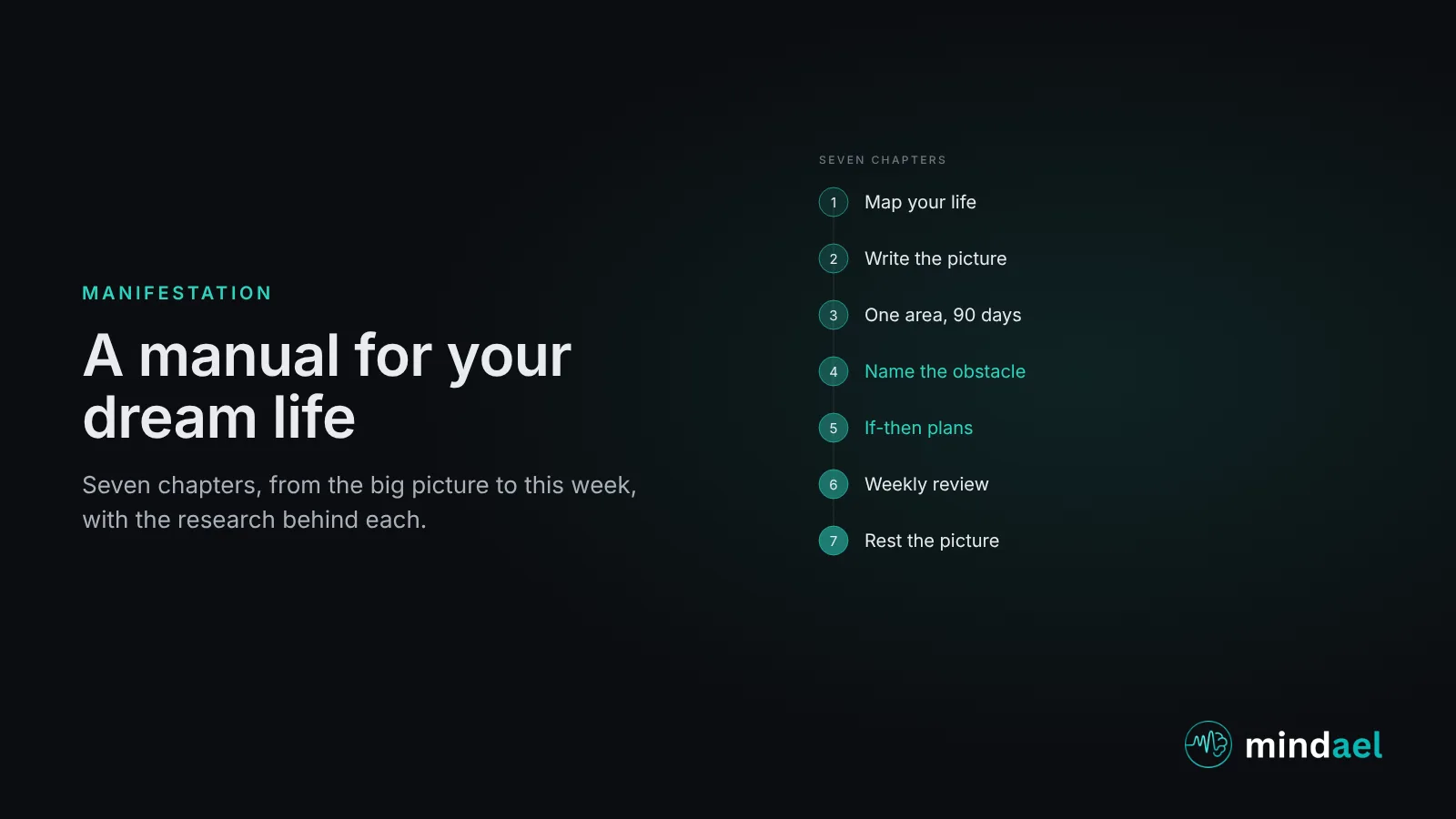
A manual for manifesting your dream life has to do something a single ritual cannot: hold many parts of a life at once and still tell you what to do this week. This one has seven short chapters. Each step comes from research on goals, and none of them promises an outcome; together they make action much more likely. We make Mindael, a sound app many people play while they write and reflect, free to download on the App Store.
Chapter 1: Map your life
Draw six areas: health, work, money, relationships, home and inner life. Score each from 1 to 10 as it is today, not as you wish it were. This takes five minutes and shows you where the gap between now and your dream life is widest.
Chapter 2: Write the picture
In one page, describe an ordinary day one year from now in the life you want. Be concrete: where you wake up, who is there, what work looks like, how your body feels. Write it in the present tense. Our guide to manifesting through writing has the full best-possible-self exercise.
Then close the notebook. Here is the honest part: in a series of experiments, people who indulged in positive fantasies about an ideal future had less energy afterwards, measured both in the body and in what they did (Kappes and Oettingen, 2011). The picture is the compass, not the engine.
Chapter 3: Choose one area for 90 days
Pick the one area where a change would help the others most, often health or money. Write one 90-day goal for it, specific enough that a friend could check it: “run 5 km without stopping”, not “get fit”. Everything else stays as it is for now.
Chapter 4: Name the obstacle inside you
Ask: what in me is most likely to stop this? Tiredness after work, scrolling, fear of being judged, saying yes to everything. Picture that moment as clearly as you pictured the dream. Pairing the wish with its obstacle and a plan, a method called mental contrasting with implementation intentions, improved goal attainment across 21 studies with almost 16,000 people (Wang et al., 2021).
Chapter 5: Write if-then plans
Turn each obstacle into a sentence: “If I get home tired, then I put on my running shoes before I sit down.” “If I open social media before 9 a.m., then I close it and open my notebook.” Across 94 tests, if-then plans like these had a medium-to-large effect on reaching goals (Gollwitzer and Sheeran, 2006). Three good plans beat ten vague ones. The four-step method for manifesting something specific walks through one goal in detail.
Chapter 6: Review every week
Fifteen minutes, same day, same place. Answer three questions on paper:
- What moved this week, even a little?
- Where did the obstacle win, and what was the moment?
- What are next week’s if-then plans?
Every 90 days, rescore the six areas from chapter 1, reread the picture, and choose the next area.
Chapter 7: Rest the picture between reviews
You do not need to visualise every day. Many people like a short daily ritual such as the 369 method or a few lines on paper; keep it if it keeps you connected to the goal, and keep it short. The days are for the plans.
The short version
Map six areas of your life, write a one-year picture, choose one area for 90 days, name the obstacle inside you, write if-then plans and review every week. The dream sets the direction; the obstacle and the plan do the work, which is what the research supports. For a calm sound while you write, Mindael is free to download on the App Store, and our manifestation sounds guide has more.

A calm fifteen minutes for your weekly review.
Mindael has rain, ocean and a stream recorded without loops, the 6 Hz theta beat and solfeggio tones made in our studio, two at a time. Press play, open the manual, write the week. Free to download, no account, works offline.
- Rain, ocean, theta beats and solfeggio tones
- Two sounds at once for writing and reflection
- Free to download, no account, works offline
 Free · No account needed · Works offline
Frequently asked questions
How do I start manifesting my dream life?
Start with a map, not a wish. Score the main areas of your life from 1 to 10, write a short picture of the life you want in a year, then choose one area to focus on for 90 days.
Does visualising my dream life make it happen?
Not on its own. In experiments, positive fantasies about an ideal future lowered people's energy. Visualising helps when you pair it with the obstacle and a concrete plan, a method that improved goal attainment across 21 studies.
Why only one area at a time?
Attention and willpower are limited. Working on one area for 90 days lets small habits settle before you add more, and progress in one part of life often spills into others.
What is an if-then plan?
A sentence that links a situation to an action: if it is 7 a.m. on a weekday, then I write for 20 minutes. Across 94 tests, plans like this had a medium-to-large effect on reaching goals.
How often should I review my dream life plan?
Once a week for 15 minutes works for most people: what moved, what got in the way, and what the next week's if-then plans are. Rewrite the big picture once every three months.
Is this the law of attraction?
It borrows the language of manifesting, but the steps come from goal research. Belief and feeling good are welcome; the plan and the weekly review are what move things.
Sources
- Kappes HB, Oettingen G. Positive fantasies about idealized futures sap energy. Journal of Experimental Social Psychology, 2011.
- Wang G, Wang Y, Gai X. A meta-analysis of the effects of mental contrasting with implementation intentions on goal attainment. Frontiers in Psychology, 2021.
- Gollwitzer PM, Sheeran P. Implementation intentions and goal achievement: a meta-analysis of effects and processes. Advances in Experimental Social Psychology, 2006.
This article is part of our manifestation and the law of attraction guide. Hear the sounds in this article in the Mindael sound library, or see our app comparison checklists.