

Sounds for Dogs: Which Sounds Calm a Dog, Which Ones Scare It, and How to Use Recordings to Ease Noise Fear
Dogs hear quieter and higher sounds than we do, so the sound world at home affects them more than we notice. Calming sounds share a few traits: steady, slow, mid to low in pitch and played quietly. In kennel studies, classical music increased sleeping and reduced barking, and audiobooks settled dogs even better, more rest and less barking than music. Frightening sounds are sudden, loud or unfamiliar: fireworks, thunder, alarms, the vacuum. Recordings can help with those too, in a different way: playing the scary sound very quietly while the dog is relaxed and paired with treats, then turning it up over weeks. In a follow-up of owners who used a recorded desensitisation programme for firework fear, most reported lasting improvement. A dog that becomes newly sensitive to noise, especially an older dog, should see a vet: in one clinic study, dogs with muscle or joint pain developed noise sensitivity later in life and avoided more of the house.
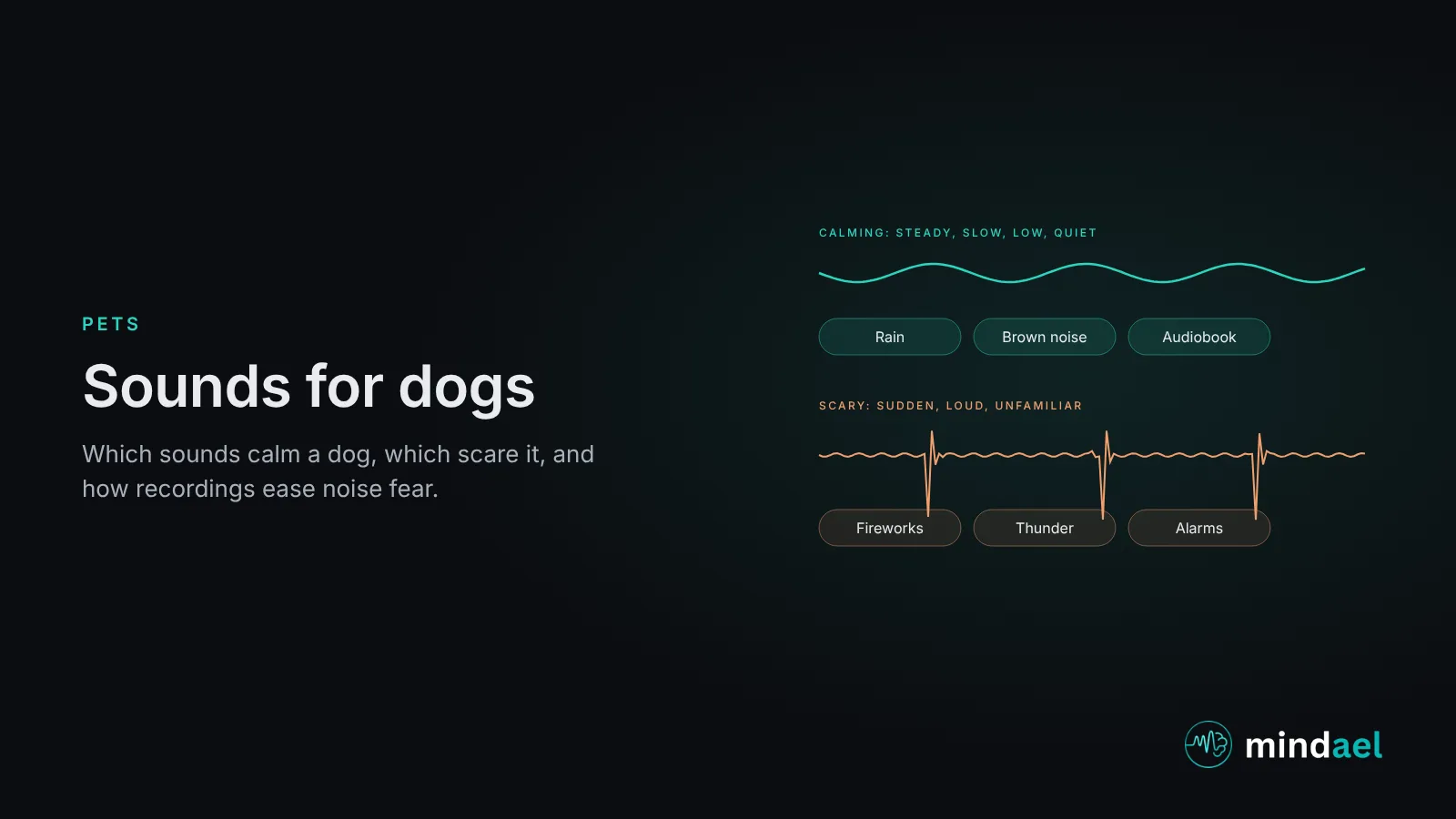
Sounds for dogs cover two very different jobs: sounds that help a dog relax, and the frightening sounds a dog needs help getting used to. Dogs hear quieter and higher sounds than we do, so the sound of a home matters more to them than we notice. This guide sorts calming sounds from scary ones, explains how recordings can ease noise fear, and says when to see a vet. We make Mindael, a sound app with steady sounds for quiet evenings, free to download on the App Store. For the research on music genres, see our music for dogs guide.
Calming sounds: steady, slow, low, quiet
The sounds that settle dogs share four traits. They are steady, without sudden changes; slow, with no driving beat; low to mid in pitch; and quiet, at about the level of a soft conversation where the dog lies.
In a study of 117 kennelled dogs, classical music increased the time dogs spent sleeping and reduced barking, while heavy metal increased body shaking (Kogan et al., 2012). A later kennel study found audiobooks worked better still: dogs spent more time resting and less time barking and standing than with classical music or silence (Brayley and Montrose, 2016). A calm, unhurried voice seems to reassure dogs in itself.
At home, good choices are:
- Soft rain for unsettled evenings. See rain sounds.
- Brown noise to cover low rumbles from the street.
- Pink noise for everyday masking of hallway noises and doors.
- An audiobook or calm talk radio when the dog is home alone.
Our noise colours guide explains why brown and pink suit dogs better than white, which has more hiss in the high frequencies dogs hear so well.
Scary sounds: sudden, loud, unfamiliar
The sounds dogs fear most arrive suddenly and loudly: fireworks, thunder, smoke alarms, sirens, the vacuum cleaner, a dropped pan. High-pitched electronic beeps can be piercing for a dog even when they seem mild to us. Signs of fear include panting, pacing, trembling, hiding, yawning and licking the lips, or trying to get out.
Using recordings to ease noise fear
Recordings of the feared sound can help, used very differently from calming sounds. The method is called desensitisation and counter-conditioning:
- Start almost silent. Play the recording so quietly the dog barely reacts.
- Pair it with something good: treats, a meal, a favourite game.
- Keep sessions short, a few minutes, and stop while the dog is still relaxed.
- Raise the volume slowly over weeks, going back a step if the dog shows any fear.
- Never flood. Playing the sound loud “to get them used to it” can make fear worse.
In a long-term follow-up of owners who used a recorded programme like this for firework fear, most reported that their dog’s improvement held up over time (Levine and Mills, 2008). Mindael does not have firework or thunder recordings; for this you need a recording made for the purpose, ideally with guidance from a vet or behaviourist.
When to see a vet
A dog that becomes newly afraid of noises, especially an older one, may be in pain. In a study of dogs seen at a behaviour clinic, those with muscle or joint pain developed noise sensitivity years later than other dogs and avoided wider areas of the house (Lopes Fagundes et al., 2018). Panic, long trembling or escape attempts also need a vet or a qualified behaviourist, not just a playlist.
The short version
Calming sounds for dogs are steady, slow, low and quiet: soft classical music, audiobooks, rain, brown or pink noise. Scary sounds are sudden and loud; recordings of them help only when used gently in a desensitisation programme. New noise fear in an older dog is a reason to see a vet. For steady sounds on a quiet evening, Mindael is free to download on the App Store, and our music for dogs guide has more.
Steady sounds for a calmer house.
Mindael has rain and ocean recorded without loops and brown and pink noise generated to spec, two at a time, to play quietly while your dog rests. There are no firework or thunder recordings in the app. Free to download, no account, works offline.
- Rain, ocean, brown and pink noise
- Two sounds at once, at a low volume
- Free to download, no account, works offline
 Free · No account needed · Works offline
Frequently asked questions
What sounds calm dogs down?
Steady, slow, low and quiet sounds. In kennel studies, soft classical music increased sleeping and reduced barking, and audiobooks settled dogs even better. At home, rain, brown noise and soft music at a low volume work the same way.
What sounds do dogs hate?
Sudden, loud or unfamiliar ones: fireworks, thunder, smoke alarms, the vacuum, sirens and sharp high-pitched noises. Dogs hear higher frequencies than we do, so some sounds that seem mild to us are piercing to them.
Can I use recordings of fireworks to help my dog?
Yes, as part of a desensitisation programme: start at a volume the dog barely notices, pair it with treats or play, and raise it slowly over weeks. Owners who followed a recorded programme for firework fear mostly reported lasting improvement. Never play it loud to get them used to it.
Should I leave sound on for my dog when I go out?
A steady sound at a low volume can cover hallway and street noises that set off barking. Introduce it while you are home first, so it means calm rather than being left alone.
Why did my dog suddenly become scared of noises?
New noise sensitivity, especially in an older dog, can be a sign of pain. In one clinic study, dogs with muscle or joint pain developed noise fear later in life than other dogs. A vet check is the first step.
How loud should sound for dogs be?
About the level of a quiet conversation, measured where the dog lies. If the dog moves away from the speaker, turn it down.
Sources
- Kogan LR, Schoenfeld-Tacher R, Simon AA. Behavioral effects of auditory stimulation on kenneled dogs. Journal of Veterinary Behavior, 2012.
- Brayley C, Montrose VT. The effects of audiobooks on the behaviour of dogs at a rehoming kennels. Applied Animal Behaviour Science, 2016.
- Levine ED, Mills DS. Long-term follow-up of the efficacy of a behavioural treatment programme for dogs with firework fears. Veterinary Record, 2008.
- Lopes Fagundes AL, et al. Noise sensitivities in dogs: an exploration of signs in dogs with and without musculoskeletal pain using qualitative content analysis. Frontiers in Veterinary Science, 2018.
This article is general information, not veterinary advice. If your dog panics, trembles for long periods, tries to escape or becomes newly afraid of noises, please see a vet or a qualified behaviourist.
This article is part of our pets and dogs guide. Hear the sounds in this article in the Mindael sound library, or see our app comparison checklists.