

Manifesting Love: What the Research on Attraction Says, and a Method That Changes What You Do
To manifest love in a way that works, aim at what you do, not at a picture of the perfect partner. In research on positive fantasies, people who indulged in happy fantasies about a hoped-for relationship were less likely to start one. What the research on attraction supports instead: being around the same people repeatedly, since familiarity increased liking in live interaction; opening up gradually and in turn, which created closeness between strangers in 45 minutes; and believing a relationship is something two people build, not something that is meant to be. So write down the values you want rather than a face, picture one brief scene, name the fear most likely to stop you, plan for it with an if-then sentence, and take one social step this week.
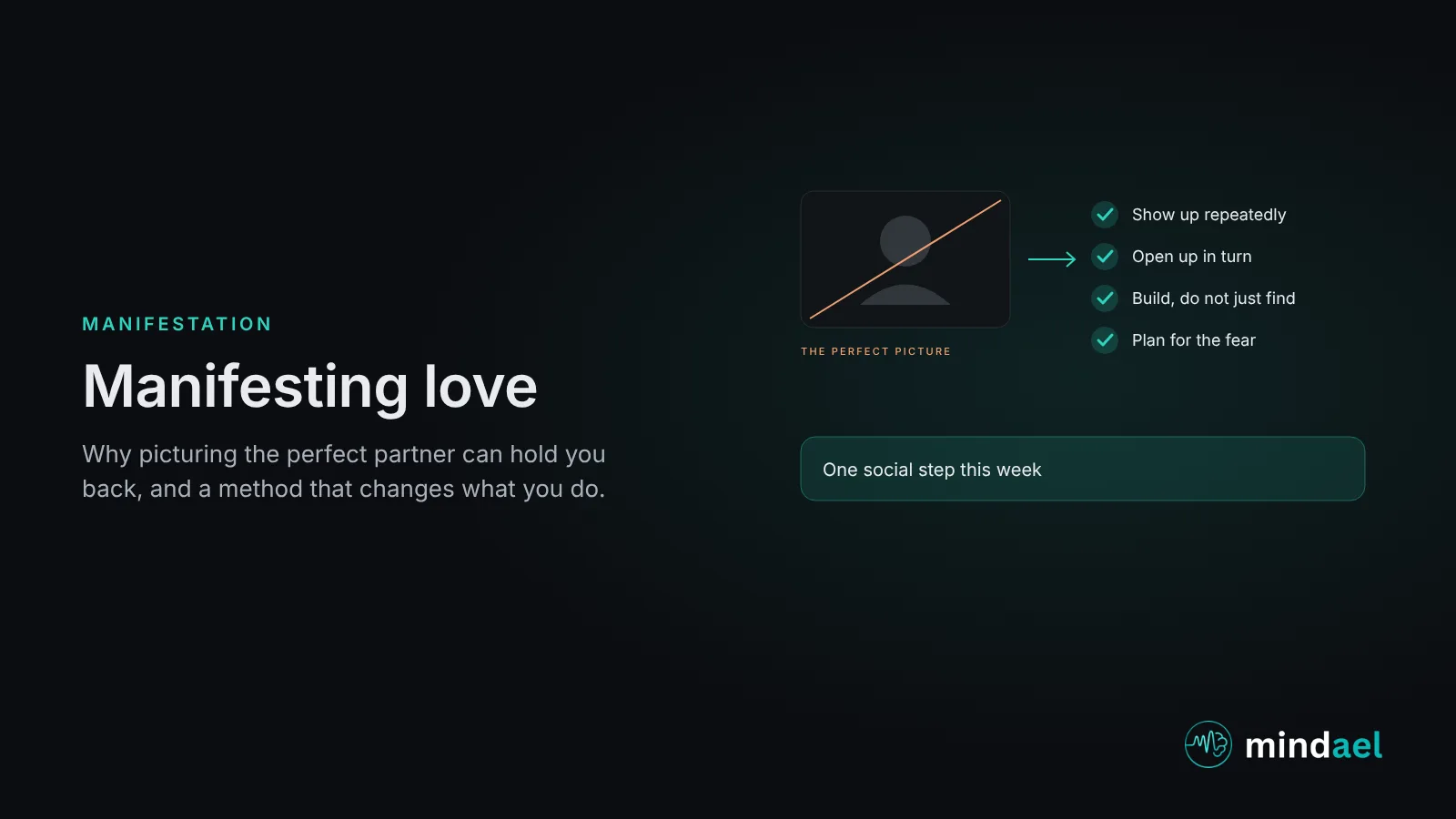
Manifesting love usually starts with a picture: the partner, the feeling, the life together. That picture is useful for knowing what you want, and the research suggests it is risky if it is all you do. This article sets out what the studies on attraction and relationships actually support, and a method that turns manifesting into things you do this week. The sound we suggest for the five-minute practice is in Mindael, free to download on the App Store, and the wider picture of the law of attraction is in our manifestation guide.
Why the perfect picture can hold you back
In a set of studies on positive fantasies, people who spent more time imagining a happy outcome did worse at reaching it than people who held more grounded expectations. One study looked at people hoping for a romantic relationship: those with more positive fantasies about it were less likely to have entered one when they were followed up (Oettingen and Mayer, 2002). A vivid fantasy can feel like progress, so the energy to take the risky step drains away. Picture the scene briefly, then move on to action. Our how do you manifest things article explains why this happens.
What the research on attraction supports
Show up repeatedly. In live interaction studies, people liked each other more the more they interacted (Reis et al., 2011). Love rarely arrives at the first meeting. It grows from seeing the same people again: a class, a club, a team, a weekly event.
Open up in turn. In a classic study, pairs of strangers who took turns answering gradually more personal questions for 45 minutes felt much closer than pairs who made small talk (Aron et al., 1997). Closeness comes from mutual, step-by-step disclosure, not from saying everything at once.
Build, do not just find. People who believe a relationship is either meant to be or not tend to give up when problems appear; people who believe relationships grow through effort tend to work through them (Knee, 1998). Manifesting “the one” can quietly encourage the first belief.
A method that changes what you do
- Write what you want as values. Kind, curious, steady, funny. How you want to feel with them. No face, no height, no job title.
- Picture one scene, briefly. A Sunday morning, an ordinary evening. One minute, then stop.
- Name the obstacle in you. The fear of rejection, the habit of staying home, the urge to leave early.
- Plan for it in one sentence. “If I want to leave, then I first talk to one new person.” If-then plans had a medium to large effect on reaching goals across nearly a hundred studies (Gollwitzer and Sheeran, 2006).
- Take one social step this week. Join something that meets weekly. Say yes to the invitation. Send the message.
If you like doing this on paper, manifesting on paper has the five-minute page.
A calm five minutes before you go out
Nerves are normal before meeting people. Five minutes with a steady sound such as ocean waves, breathing in on the swell and out on the fall, can take the edge off. Then run the plan: one scene, one fear, one if-then. Our how to calm your nerves article has the full routine.
The short version
Picture the relationship briefly, then aim at what you do. Show up in the same places repeatedly, open up a little more each time, believe that love is built, and plan for the fear that keeps you home. That is manifesting love in the only sense the research supports: by making it more likely that you meet someone and let them know you.

Five calm minutes before you go out.
Mindael has rain and ocean recorded without loops and theta beats made in our studio, two at a time. Free to download, no account, works offline. Press play, picture one scene, name the fear, plan for it, then go and meet people.
- Rain, ocean and theta beats, studio-made
- The same sound every time, as a cue
- Free to download, no account, works offline
 Free · No account needed · Works offline
Frequently asked questions
How do you manifest love?
Name what you want in a relationship as values, not a face. Picture one brief scene of it. Then name the fear or habit most likely to stop you and plan for it: 'if I want to leave the party early, then I talk to one new person first.' Take one social step this week. The research on attraction says love grows from repeated contact and gradual openness, so the method aims there.
Can you manifest a specific person?
You can change how you show up with them, which matters. You cannot decide another person's feelings. Fixing on one person who has not shown interest tends to keep people from meeting others, so we suggest manifesting the kind of relationship you want and staying open about who.
Does visualising your perfect partner work?
Briefly, as a way to know what you want, yes. At length, it can backfire: in research on positive fantasies, people who spent more time imagining a happy romantic outcome were less likely to make it happen, probably because the fantasy feels like progress.
How long does it take to manifest love?
As long as meeting the right person takes, which no method controls. What you control is how many chances you create. Being around the same people week after week, and letting conversations go a little deeper, are the two things the research most clearly connects with attraction.
What are signs love is coming?
The useful signs are things you are doing: you are meeting new people regularly, you are seeing some of them again, and conversations are becoming more personal. Signs from the universe are what attention finds when it is looking for them.
Should I write a list of what I want in a partner?
Yes, but write values and how you want to feel, not a height or a job. A list of qualities helps you notice who fits; a fixed checklist makes you dismiss people before you know them.
Sources
- Oettingen G, Mayer D. The motivating function of thinking about the future: expectations versus fantasies. Journal of Personality and Social Psychology, 2002.
- Reis HT, et al. Familiarity does indeed promote attraction in live interaction. Journal of Personality and Social Psychology, 2011.
- Aron A, et al. The experimental generation of interpersonal closeness: a procedure and some preliminary findings. Personality and Social Psychology Bulletin, 1997.
- Knee CR. Implicit theories of relationships: assessment and prediction of romantic relationship initiation, coping, and longevity. Journal of Personality and Social Psychology, 1998.
- Gollwitzer PM, Sheeran P. Implementation intentions and goal achievement: a meta-analysis of effects and processes. Advances in Experimental Social Psychology, 2006.
This article is for general information and is not psychological or relationship advice. Manifesting methods change what you notice and do, not another person's feelings or choices. If loneliness or a relationship is affecting your mood or safety, please talk to a doctor, a therapist or a local support service.
This article is part of our manifestation and the law of attraction guide. Hear the sounds in this article in the Mindael sound library, or see our app comparison checklists.