
Best ADHD App: What an App for ADHD Should Actually Do, With the Research, and Where Mindael Fits
Searches for an ADHD app usually mean one of two things: help remembering, or help starting. Reminder and calendar apps cover the first. This page is about the second, the task that is not hard but will not begin, because that is where the research on sound is clearest and where Mindael, a sound app with a block timer, is built to help. Below is the checklist of what an app for ADHD should do to make starting easier, where each item comes from, and what Mindael does not do, so you know what to pair it with. Free to download on the App Store.
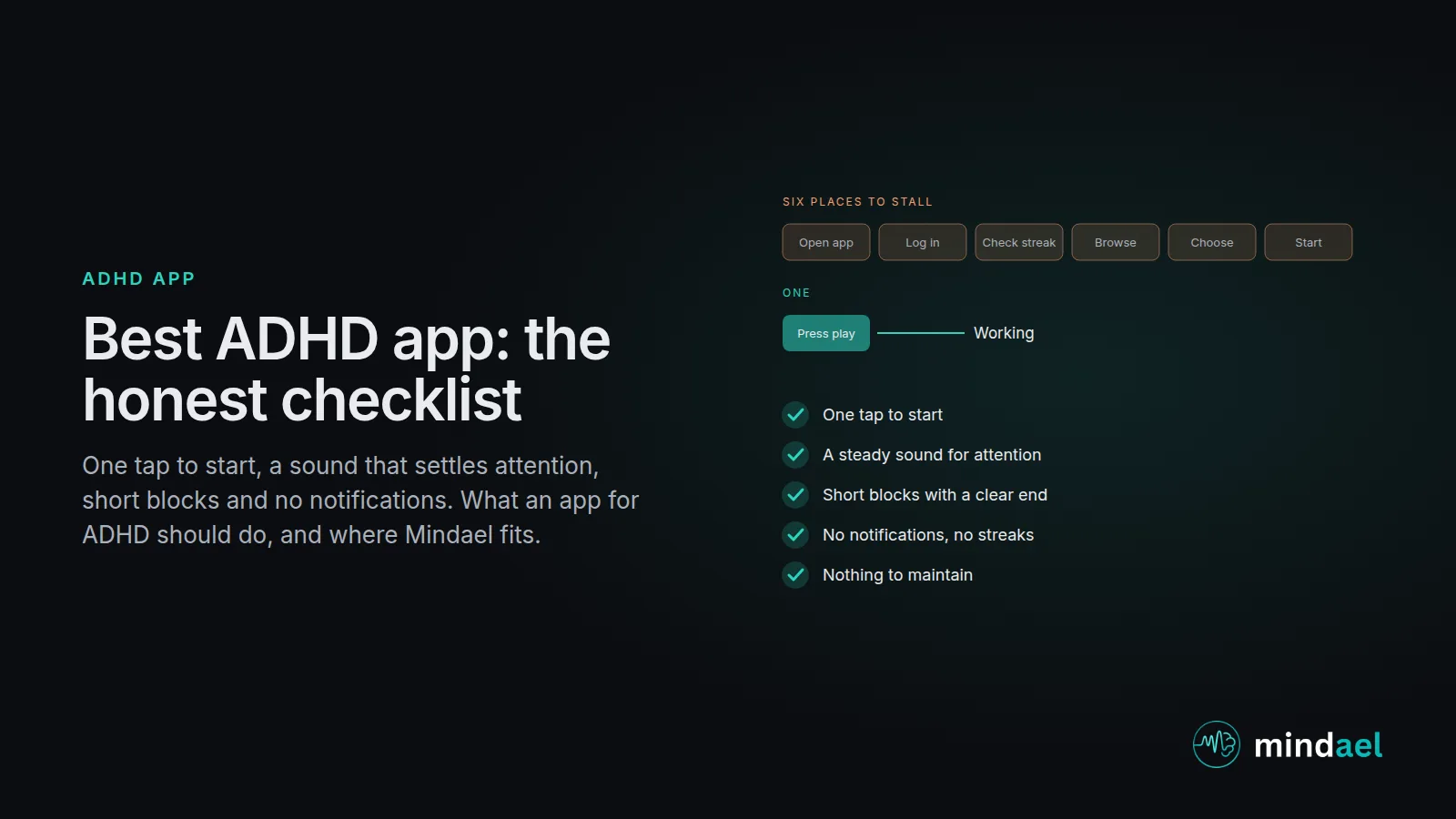
The best ADHD app for getting started is the one with the fewest steps between opening it and working: one tap to a steady sound, a short block with a clear end, no notifications pulling you back to the phone, and nothing to set up, log or maintain. A 2024 meta-analysis found small but consistent attention gains from white and pink noise in young people with ADHD. Mindael has brown, pink and white noise generated to spec, rain and beta beats, mixed two at a time, offline and with no account, free to download. It is not a reminder, calendar or to-do app and does not do body doubling; most of our ADHD listeners run it next to one.
What to look for, and how Mindael covers it
| What you need | In Mindael |
|---|---|
| One tap from open to working | Open the app, the last sound is there, press play. No feed, no onboarding, no account |
| A sound that settles attention | Brown, pink and white noise generated to spec, rain recorded without loops |
| Short blocks with a clear end | A block timer with a fade at the end, so a task has a shape instead of an afternoon |
| A sharper option for boring tasks | A beta beat under brown noise for forms, admin and past papers |
| No notifications, no streaks | Mindael never pings you and keeps no score to fall behind on |
| Nothing to maintain | No lists to keep up, no data to sync. If you drop it for a week, nothing has rotted |
| Works offline, screen locked | Every sound is on the phone; it keeps playing face down in another room |
| Price | Free to download on the App Store |
What an ADHD app is for
Most people with ADHD do not need an app to tell them what to do. They know. The problem is the gap between knowing and starting, and the drift once started. An app earns its place on the home screen if it shrinks that gap, and loses it the moment it adds steps, settings or guilt. That is the test behind every item on the checklist above. Our ADHD sounds guide explains the sound side in full; this page is about choosing the tool.
The checklist, explained
One tap from open to working. Every screen between you and the task is a place to stall. The best ADHD app opens on the thing you used last and plays it. No feed, no daily quote, no login.
A sound that settles attention. This is the item with real research behind it. Children with attention problems remembered more under white noise, while children without those problems did slightly worse under the same noise (Söderlund et al., 2007). A 2024 meta-analysis pooled the studies and found small but consistent gains in attention in young people with ADHD or elevated attention problems (Nigg et al., 2024). Most adults end up on brown noise, the same principle with the hiss removed; our brown noise article covers why.
Short blocks with a clear end. A task with no end is an afternoon, and an afternoon is too big to start. A block of fifteen or twenty-five minutes is small enough. In a trial with students, fixed scheduled breaks left people less tired and better able to concentrate than breaks taken when they felt like it (Biwer et al., 2023). The Pomodoro guide has the lengths.
An if-then plan the app can trigger. “When the sound starts, I open the file” is an implementation intention, a plan tied to a cue. In children with ADHD, if-then plans improved response inhibition in lab tasks (Gawrilow and Gollwitzer, 2008). The sound is a good cue because pressing play is easy and always the same.
No notifications. Even a notification you do not open costs attention: in one study, simply receiving a phone notification increased errors on an attention task, by an amount comparable to actually using the phone (Stothart et al., 2015). An app that pings you to keep a streak alive is working against the job you downloaded it for.
Nothing to maintain. Lists, tags and streaks need upkeep, and an ADHD week has gaps. A tool that punishes the gap gets abandoned. A sound app with nothing stored has nothing to fall behind on.
What Mindael does not do
Mindael does not remind you, plan your day, track habits or do body doubling. If remembering is the problem, a reminder or calendar app is the right tool, and the one you already have is usually best. If working alone is the problem, body doubling with a friend or an online session works for many people, and brown noise in one earbud under it is a combination our listeners like. Mindael is the start button: one sound, one block. For the habits around the block, the how to concentrate better article has them, and for students the study timer checklist is the same idea for revision. Nothing here replaces diagnosis or treatment; that belongs with a doctor.
How to switch in five minutes
- Download MindaelFree on the App Store. No account, so there is no sign-up step to stall on.
- Pick one sound and keep itBrown noise, for two weeks. Browsing sounds is a pleasant way to not start; choosing once removes the choice.
- Write the first action on paperNot the task, the first physical action: open the file, write the heading. If-then: when the sound starts, I open the file.
- Press play, then startThe sound comes first and cannot be failed. By the time it is playing you have already begun.
- Run one short blockFifteen or twenty-five minutes, phone face down. When the sound fades, stand up. One block counts as a win.
Press play. You have started.
Mindael has brown, pink and white noise generated to spec, rain recorded without loops and beta beats made in our studio, two at a time, under a block that fades out instead of ringing. Free to download, no account, works offline. One tap from the lock screen to working.
- Brown, pink and white noise, rain and beta beats, studio-made
- Short work blocks with a fade at the end
- Free to download, no account, no notifications
 Free · No account needed · Works offline
Frequently asked questions
What is the best app for ADHD?
It depends which part of ADHD the app is for. For remembering, a reminder or calendar app you already trust. For starting and staying on a task, an app with the fewest steps to a steady sound and a short block, with no notifications of its own. Mindael is built for that second job, free to download, and most of our listeners pair it with a reminder app.
Is Mindael an ADHD app?
It is a sound app that many people with ADHD use, mainly brown noise under a short work block. It is not a treatment, a planner or a reminder app. We built the focus side around the research on noise and attention, which is described on our ADHD sounds page.
Does brown noise help ADHD?
The studies used white and pink noise, and a 2024 meta-analysis found small but consistent improvements in attention in young people with ADHD or attention problems. Brown noise works on the same principle with the sharp top end removed, which is why many adults with ADHD prefer it. Effects vary person to person; try it for two weeks, quieter than feels right.
Does Mindael do body doubling?
No. Body doubling means working alongside another person, in a room or on a video call, and it needs a person. Some of our listeners use a body doubling session and run brown noise in one earbud underneath; the two work well together.
Does Mindael have reminders or a to-do list?
No, on purpose. Reminders are a different tool, and an app that does everything tends to become one more thing to manage. Keep the reminder app you already use and let Mindael be the one-tap start.
Is an app a substitute for ADHD treatment?
No. The researchers behind the noise studies describe noise as a low-cost support alongside standard care, not instead of it, and that is how we see Mindael too. Diagnosis and treatment belong with a doctor.
Sources
- Nigg JT, et al. Auditory white and pink noise for attention in youth with ADHD or elevated attention problems: systematic review and meta-analysis. Journal of the American Academy of Child and Adolescent Psychiatry, 2024.
- Söderlund G, Sikström S, Smart A. Listen to the noise: noise is beneficial for cognitive performance in ADHD. Journal of Child Psychology and Psychiatry, 2007.
- Gawrilow C, Gollwitzer PM. Implementation intentions facilitate response inhibition in children with ADHD. Cognitive Therapy and Research, 2008.
- Stothart C, Mitchum A, Yehnert C. The attentional cost of receiving a cell phone notification. Journal of Experimental Psychology: Human Perception and Performance, 2015.
- Biwer F, et al. Understanding effort regulation: comparing "Pomodoro" breaks and self-regulated breaks. British Journal of Educational Psychology, 2023.