

Sensitive People Meaning: What 'Sensitive' and 'Highly Sensitive' Actually Mean, the Four Signs, and How It Differs From Being Emotional
In everyday speech a sensitive person is someone easily hurt or easily moved. In psychology the phrase 'highly sensitive person' means something more specific: a person high in sensory processing sensitivity, a stable temperament trait found in roughly 20 to 35 percent of people. Its four signs, sometimes remembered as DOES, are depth of processing, overstimulation, emotional reactivity and empathy, and sensitivity to subtleties. It is not the same as being emotional, shy, introverted or anxious, though it can overlap with each, and it is not a diagnosis. Sensitive people respond more strongly to their environment in both directions, worse in a harsh one and better than average in a supportive one, which is why the practical meaning of the label is about arranging surroundings, including sound, rather than toughening up.
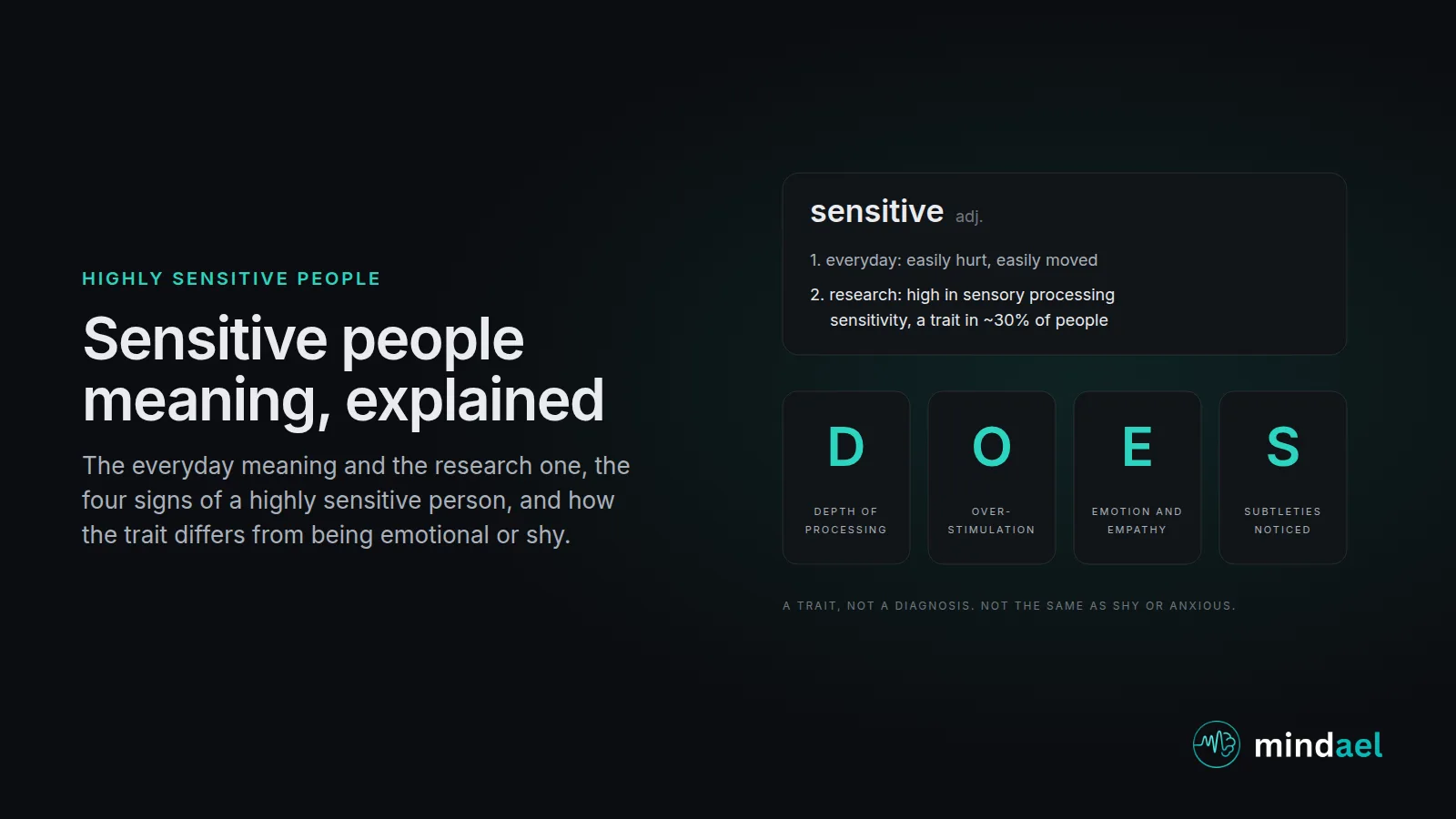
Sensitive people meaning depends on who is using the word. In ordinary speech a sensitive person is someone easily hurt, or easily moved, and it is often said as a mild criticism. In psychology, “highly sensitive person” means something narrower, measurable and not a criticism at all: a temperament trait with a research literature going back to 1997. This article explains both meanings, the four signs the research uses, how the trait differs from being emotional, shy or anxious, and what the label is actually useful for. The steady sounds many of our sensitive listeners use are in Mindael, free to download on the App Store, and the practical side, a day arranged around the trait, is in our highly sensitive people guide.
The everyday meaning
“Don’t be so sensitive” usually means: you are reacting more than the situation deserves. The everyday word bundles several things together: being easily hurt by criticism, crying easily, being moved by music, being bothered by things other people do not notice, taking a long time to get over a bad day. Some of those are about emotion and some are about the senses, and the everyday word does not separate them. That is the main thing the research meaning adds.
The research meaning
In 1997 the psychologists Elaine and Arthur Aron published a scale for what they called sensory processing sensitivity, after finding in interviews and surveys that a consistent group of people, around a fifth of their samples, described the same cluster of experiences: overwhelmed by noise and busy places, deeply affected by art and other people’s moods, aware of subtleties, needing downtime after stimulating days (Aron and Aron, 1997). Later work across large samples found roughly 30 percent of people in the high group, 40 percent in the middle and 30 percent low (Lionetti et al., 2018). The trait has been found in more than a hundred other species, which suggests it is a survival strategy, pausing to notice before acting, rather than a fault (Aron et al., 2012).
The four signs, DOES
The research uses four features, often remembered by the letters D, O, E and S.
D, depth of processing. Thinking things over, noticing implications, taking longer to decide because more is being weighed. In a 2014 fMRI study, highly sensitive people showed stronger activity in brain regions for attention, empathy and planning when looking at other people’s facial expressions (Acevedo et al., 2014).
O, overstimulation. Tiring faster in loud, bright or crowded places, needing quiet after social events, finding a full day of input exhausting. This is the sign that most people notice first, and the one sound helps with most.
E, emotional reactivity and empathy. Feeling things strongly, positive and negative, and picking up other people’s moods. This is the part closest to the everyday meaning.
S, sensitivity to subtleties. Noticing the hum of a fridge, the scratch of a label, a small change in someone’s tone, a picture moved on a wall.
One or two of these say little; most people have some. The trait is all four together, most of the time.
What it is not
Not the same as being emotional. Emotional reactivity is one of the four signs, but someone can be emotionally intense without the sensory side, and a highly sensitive person can be calm and even-tempered most of the time if their surroundings let them.
Not the same as shy or introverted. About a third of highly sensitive people in the original studies were extraverts. The need for time alone after busy days is about overstimulation, not about preferring solitude.
Not the same as anxious. Sensitivity can make anxiety more likely in a harsh environment, but the trait itself is about processing, not fear. Many sensitive people are not anxious, and many anxious people are not highly sensitive; our anxiety guide covers the anxiety side.
Not a diagnosis. It is a normal variation in temperament. It overlaps with sensory overload in autism and ADHD, and some people have both; if sensitivity comes with difficulties in social communication or attention that disrupt daily life, an assessment is worth having, because the support is different.
What the label is useful for
A 2019 review placed the trait inside a broader idea, environmental sensitivity: sensitive people are more affected by their surroundings in both directions, doing worse than average in harsh conditions and better than average in supportive ones (Greven et al., 2019). That is the practical meaning of the word. It is not “you need to toughen up”, and it is not “you are fragile”. It is: your surroundings matter more for you than for most people, so they are worth arranging.
Sound is the cheapest part of that to change. What overstimulates is rarely volume and mostly contrast: sudden voices, doors, laughter in a quiet room. A steady, low sound such as green noise or brown noise raises the floor of a room so those spikes stop registering as events, and our noise colours comparison explains which colour does what. For the evening after a loud day, rain low and a slow routine; our how to relax your nervous system article has one that fits a sensitive body, and the highly sensitive people guide puts the whole day together.
The short version
In everyday speech, sensitive means easily hurt or easily moved. In the research, a highly sensitive person has a temperament trait shared by roughly a third of people: depth of processing, overstimulation, emotional reactivity and empathy, and sensitivity to subtleties. It is not the same as being emotional, shy, introverted or anxious, and it is not a diagnosis. Its practical meaning is that surroundings matter more, in both directions, and sound is the easiest part of them to change.
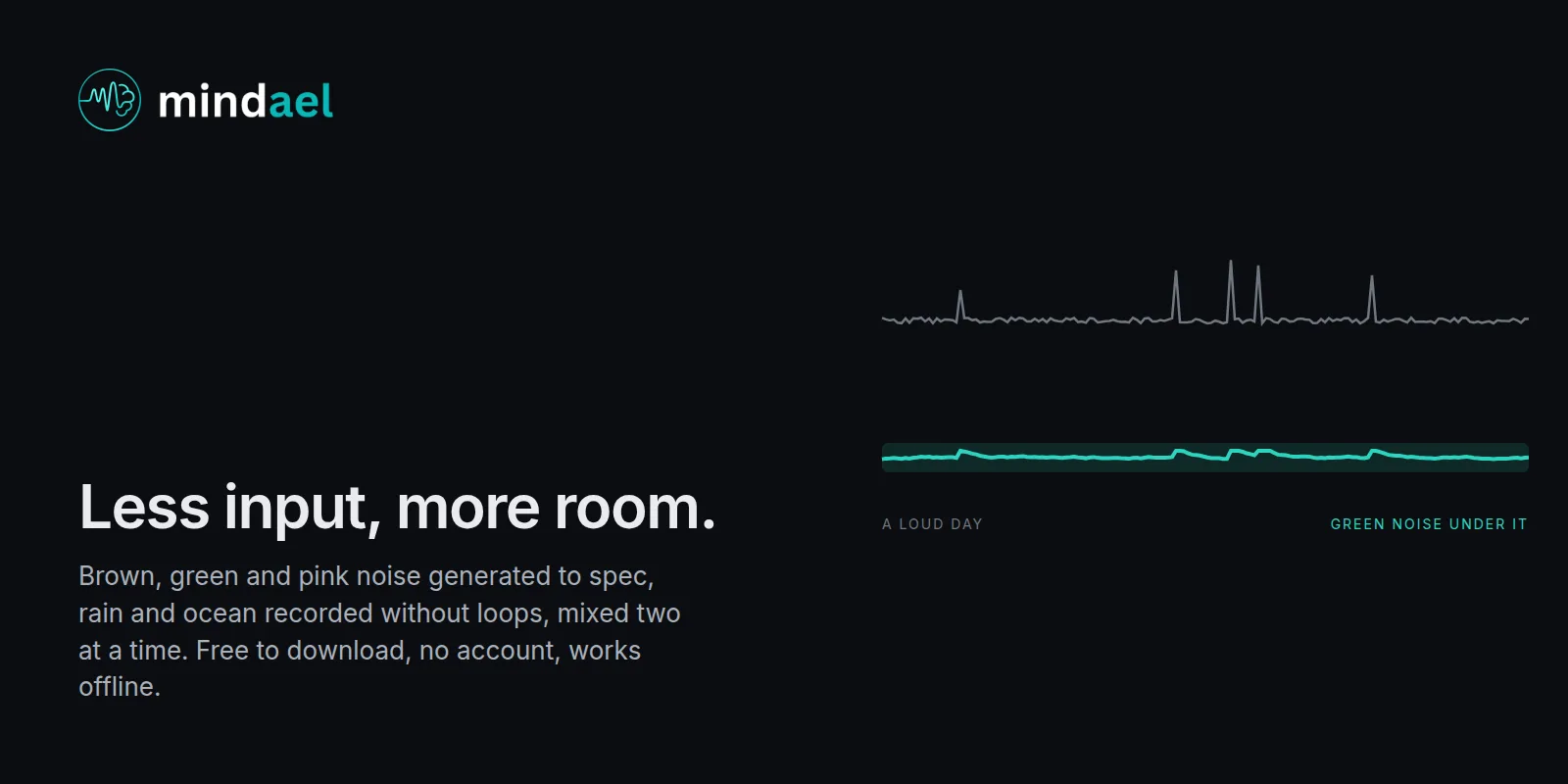
Less input, more room.
Mindael has brown, green and pink noise generated to spec, rain and ocean recorded without loops, and low tones made in our studio, mixed two at a time with a timer that fades. Free to download, no account, works offline. A steady sound under a loud day, and the same one for the quiet evening after it.
- Brown, green and pink noise, rain and ocean, studio-made
- Two sounds at once, a timer that fades
- Free to download, no account, works offline
 Free · No account needed · Works offline
Frequently asked questions
What does it mean to be a sensitive person?
In everyday use, someone who is easily hurt by criticism or easily moved by art and other people. In psychology, a highly sensitive person is someone high in sensory processing sensitivity: they process experience more deeply, get overstimulated more easily, react more strongly emotionally, and notice subtle details. About a fifth to a third of people fall in that group.
What is the meaning of a highly sensitive person?
A person high in sensory processing sensitivity, a temperament trait first described by psychologists Elaine and Arthur Aron in 1997. The four features are depth of processing, ease of overstimulation, emotional reactivity with strong empathy, and sensitivity to subtleties. It is a normal variation in temperament, not a disorder.
What does an emotionally sensitive person mean?
Someone whose emotions run strong and close to the surface, and who picks up other people's moods easily. Emotional reactivity is one of the four parts of high sensitivity, but someone can be emotionally sensitive without the sensory side, being bothered by noise, light and texture, that defines the trait in the research.
Is being sensitive the same as being shy or introverted?
No. About 30 percent of highly sensitive people are extraverts, and many shy people are not highly sensitive. Sensitive people often need time alone after busy days because they are overstimulated, which looks like introversion from the outside but has a different cause.
Is being highly sensitive a disorder?
No. It is a temperament trait present in a large minority of people, and in many other species too, which suggests it is an adaptive strategy rather than a fault. It overlaps with sensory overload in autism and ADHD, and with anxiety, so if sensitivity comes with difficulties that disrupt daily life, an assessment is worth having.
What are the signs of a highly sensitive person?
Needing downtime after busy or social days; being bothered by noise, bright light, strong smells or scratchy fabric; being deeply moved by music or art; noticing small changes in a room or a tone of voice; thinking decisions over for a long time; feeling other people's moods; and being startled easily. One or two of these mean little; most of them together is the trait.
Sources
- Aron EN, Aron A. Sensory-processing sensitivity and its relation to introversion and emotionality. Journal of Personality and Social Psychology, 1997.
- Aron EN, Aron A, Jagiellowicz J. Sensory processing sensitivity: a review in the light of the evolution of biological responsivity. Personality and Social Psychology Review, 2012.
- Lionetti F, et al. Dandelions, tulips and orchids: evidence for the existence of low-sensitive, medium-sensitive and high-sensitive individuals. Translational Psychiatry, 2018.
- Acevedo BP, et al. The highly sensitive brain: an fMRI study of sensory processing sensitivity and response to others' emotions. Brain and Behavior, 2014.
- Greven CU, et al. Sensory processing sensitivity in the context of environmental sensitivity: a critical review and development of research agenda. Neuroscience & Biobehavioral Reviews, 2019.
This article is for general information and is not medical or psychological advice. High sensitivity is a temperament trait, not a diagnosis. If sensory overload, anxiety or low mood is disrupting your life, or comes with difficulties in attention or social communication, please talk to a doctor or psychologist.
This article is part of our highly sensitive people guide. Hear the sounds in this article in the Mindael sound library, or see our app comparison checklists.