
A Free Alternative to Headspace for Meditation Sounds, Sleep Sounds and a Quiet Timer
Most "headspace meditation" searches are from people who want to meditate and are weighing whether a guided, subscription app is the way in. Some of them want the voice and the courses, and for those an app built around teaching is the right tool. Some want the other half: a quiet place to sit, a sound to hold, a timer that ends softly, and nothing talking. Mindael is built for the second group. Theta beats, drones, bowl-like tones, rain and ocean made in our studio, two at a time, offline, no account. Free to download on the App Store. This page says what it does, what it does not, and which kind of person each suits.
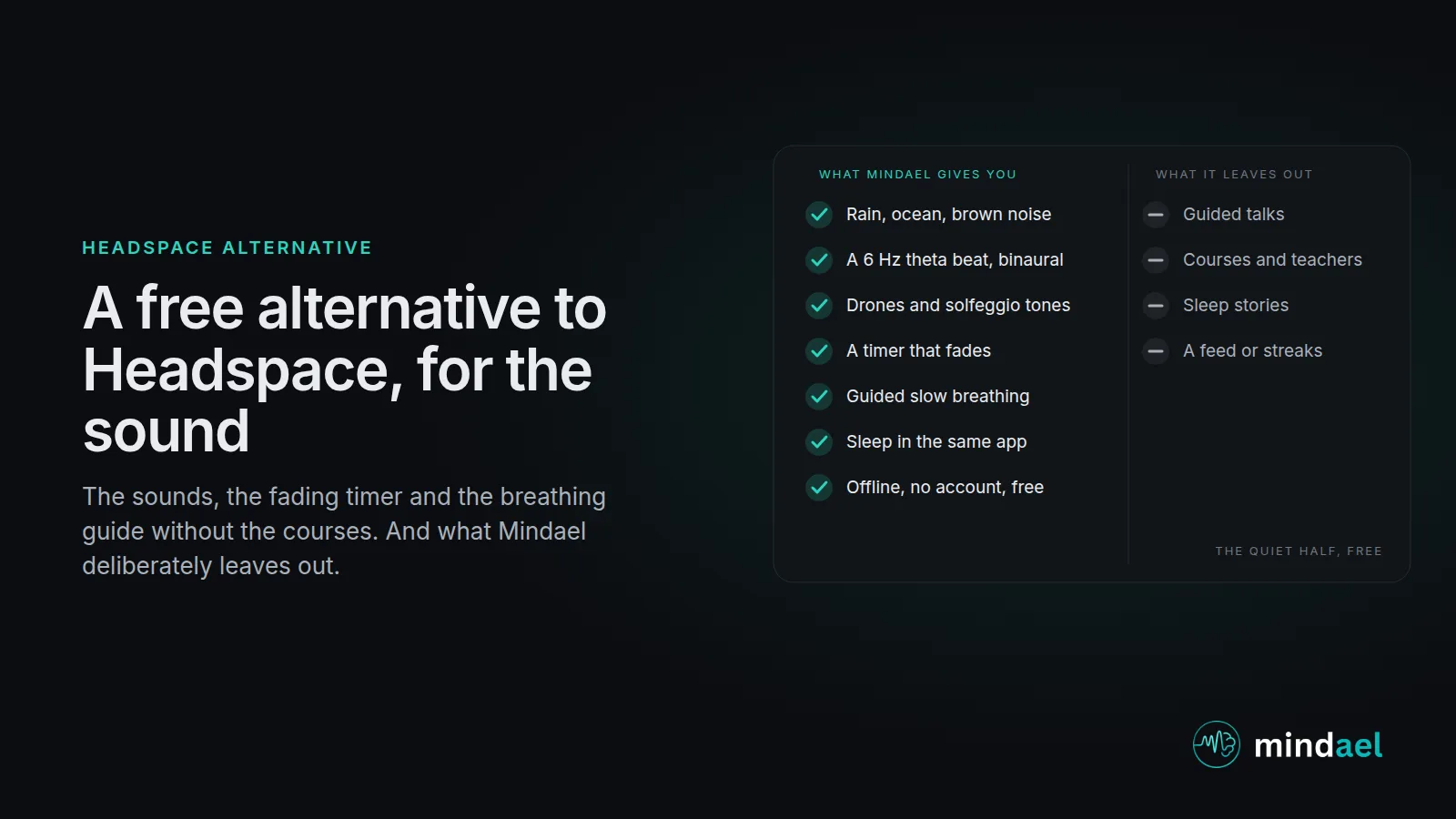
For the sound side of meditation, Mindael is a good free alternative: a 6 Hz theta beat with research behind it, low drones and the nine solfeggio tones, rain and ocean recorded without loops, two-sound mixing, a timer that fades instead of ringing, guided slow breathing, offline play and no account. It has no guided meditations, no courses, no teachers and no sleepcasts; if a voice walking you through the sit is what you want, it is not a replacement. If you have a teacher or a free recording already, or you want to sit in sound and silence, it is the quieter tool, and it covers the night's sleep and the focus block with the same sounds.
What to look for, and how Mindael covers it
| What you need | In Mindael |
|---|---|
| A sound to sit with | Rain, ocean, stream and brown noise, recorded or generated in our studio with no loop to notice |
| A theta beat with research | A 6 Hz theta beat on a clean carrier, for earbuds; a 2017 study found it raised theta activity within ten minutes |
| Drones and tones | Sustained low drones, bowl-like tones and the nine solfeggio frequencies, precise to the hertz |
| A timer that ends gently | The sound fades at the end of the sit instead of a bell |
| Guided slow breathing | Breathing patterns at around six breaths a minute, shown on screen, over any sound |
| Sleep with the same app | Rain, brown noise and a 3 Hz delta beat under a fading timer for the night |
| Mixing, offline, no account | Two sounds at once, every sound on the phone, nothing to sign up for |
| Price | Free to download on the App Store |
Two halves of a meditation app
Strip any meditation app down and there are two halves. One is instruction: a voice that tells you where to put your attention, courses that build a habit, a programme with a beginning. The other is the room: a sound that holds steady, a timer that ends without a jolt, and nothing else. Apps built around teaching are very good at the first half and charge for it. Mindael only does the second half, and does it free. The honest comparison is not “which is better” but “which half are you missing”.
The evidence, for what it is worth, is about the practice rather than the delivery: a 2014 review of 47 trials found moderate benefits for anxiety, depression and pain from meditation programmes (Goyal et al., 2014). Whether you got there by a voice or by sitting in rain is not what the studies measured. Our meditation sounds guide has three sessions to run this week, and the how to start transcendental meditation article covers a mantra practice that needs no app at all.
The checklist, explained
A sound to sit with. For most beginners the breath is a hard anchor and a sound is an easy one. Rain recorded long enough that there is no loop to notice, brown noise generated continuously, a stream for people who find rain busy. A 2021 synthesis of studies found natural sound, water sounds most consistently, lowered stress and improved mood (Buxton et al., 2021).
A theta beat with research. Binaural beats are often sold loosely; a real one needs two slightly different tones, one per ear, on a clean carrier, in earbuds. Mindael’s 6 Hz beat is built that way, and 6 Hz is the frequency with the clearest result: it raised theta activity, the rhythm of settled meditation, within ten minutes in a 2017 EEG study (Jirakittayakorn and Wongsawat, 2017). The theta waves page has the detail and the binaural beats article the background.
Drones and tones. Sustained low drones and bowl-like tones for the sound-bath style of sit, and the nine solfeggio frequencies as a soft layer, each tuned to the hertz. We present the traditions around those tones as traditions; the tones themselves are precise.
A timer that ends gently. A bell at the end is traditional and, for many, a small shock. Mindael fades the sound instead, so the sit ends as a softening.
Guided slow breathing. A breathing pattern on screen at around six breaths a minute, the rate that raises heart rate variability and lowers anxiety across many studies (Zaccaro et al., 2018), running over whichever sound you chose. The breathing guide has the patterns and when to use each.
Sleep in the same app. The night is where many people first meet a meditation app, through sleep content. Mindael handles it with sound rather than stories: rain or brown noise and a 3 Hz delta beat under a fading timer, set up in the sleep sounds guide.
What Mindael does not do
It has no guided meditations, no courses, no teachers, no sleep stories and no progress tracking. If a voice walking you through the sit is what you are looking for, Mindael is not that, and we would rather say so here than after you download it. The way most of our listeners square it: a free guided recording from any source on top, Mindael underneath as the floor, and on the nights they want no voice, just the sound. If what you want is the subscription-free version of a sleep app rather than a meditation app, the Calm alternative page is the closer read; if it is the timer and the sounds without the community feed, the Insight Timer alternative page is.
Who each half suits
A voice-led app suits someone starting from zero who wants to be taught, likes a programme with a next lesson, and will use the courses. Mindael suits someone who already has a practice, a teacher or a recording, who found the guided apps noisy, who meditates to sound or in silence, and who wants the evening sit, the night’s sleep and the focus block from one quiet app. Our free meditation apps checklist is the version of this page with no competitor in the search at all.
How to switch in five minutes
- Download MindaelFree on the App Store, no account needed to listen.
- Pick one sound and sitRain for a plain ten-minute sit. The 6 Hz theta beat in earbuds under a low drone when you want the deeper version.
- Breathe with the guide for the first minuteFour in, six out, following the pattern on screen, then let the breath go natural and stay with the sound.
- Let it fadeSet the timer so the sound fades rather than stops. Sit a minute in the silence afterwards.
- Keep a voice if you want onePlay any free guided recording over the top. Mindael stays underneath as the floor, and the sound is there on the nights you want no voice at all.
The quiet half of meditation.
Theta beats, drones, bowl tones, rain and ocean from our studio, a timer that fades, guided slow breathing, offline and no account. Download Mindael and sit down tonight, with or without a voice on top.
- Theta beats, drones, rain and ocean, studio-made
- A fade at the end, a breathing guide on top, sleep in the same app
- Free to download, no account, works offline
 Free · No account needed · Works offline
Frequently asked questions
Is Mindael a free alternative to Headspace?
For the sound half, yes: meditation sounds, sleep sounds, a fading timer and a breathing guide, free to download with no account. For the guided half, no: Mindael has no talks, courses or teachers. Which half you need decides which app you need.
Does Mindael have guided meditations?
No. It is a sound app on purpose. If you want a voice, play a free guided recording from any source over the sound; if you want quiet, this is the app for it.
What is the best sound to meditate to?
For a seated sit, a 6 Hz theta beat under a soft drone, in earbuds, has the clearest research. For body-based or sound-bath sessions, bowl tones and the lower solfeggio frequencies. For beginners, plain rain, because it asks nothing of you. Keep whichever you choose low.
Can I use it for sleep as well?
Yes. The same app runs rain, brown noise and a delta beat under a fading timer for the night, and the sleep sounds guide has the setup. One app for the evening sit and the night after it.
Does it work offline?
Yes. Every sound is on the phone, so it works on a flight, in a basement or with the data off.
Is meditating to sound as good as a guided meditation?
They are different practices. The evidence for meditation is about the practice itself, not the delivery: a 2014 review found moderate benefits for anxiety, depression and pain across programmes. A sound gives attention an easy anchor and masks the room; a voice gives instruction. Many people use a voice to learn and sound once they know what they are doing.
Sources
- Goyal M, et al. Meditation programs for psychological stress and well-being: a systematic review and meta-analysis. JAMA Internal Medicine, 2014.
- Jirakittayakorn N, Wongsawat Y. Brain responses to a 6-Hz binaural beat: effects on general theta rhythm and frontal midline theta activity. Frontiers in Neuroscience, 2017.
- Zaccaro A, et al. How breath-control can change your life: a systematic review on psycho-physiological correlates of slow breathing. Frontiers in Human Neuroscience, 2018.
- Buxton RT, et al. A synthesis of health benefits of natural sounds and their distribution in national parks. PNAS, 2021.