Over the last couple of years, brown noise has quietly taken over TikTok, Reddit threads, and YouTube focus playlists. Millions of people now press play on a deep, rumbling sound the moment they sit down to work or get into bed. Some say it makes their thoughts go quiet for the first time in years. Others use it to fall asleep faster on noisy city streets.
So what is this sound, really, and why is it suddenly everywhere? In this article we will look at what brown noise actually is, how it differs from other colors of noise, what scientists have learned about it so far, and how to use it in a way that actually helps you focus, sleep, or quiet an ADHD brain.
What Is Brown Noise?
Brown noise is a type of random sound where most of the energy sits in the low frequencies. The higher you go up the spectrum, the quieter the sound gets. The result is a deep, soft rumble that feels closer to a waterfall or heavy rain than to the static hiss most people picture when they hear the word "noise."
The name has nothing to do with the color brown. It comes from a 19th century botanist named Robert Brown, who described the random jittering of pollen grains in water. That motion is now called Brownian motion, and the same mathematical pattern shows up in this kind of sound. Engineers borrowed the name to describe a noise whose power drops off steeply as the frequency rises.
If you have ever stood near a waterfall, listened to wind moving through a canyon, or heard a jet engine from far away, you have a good mental picture of brown noise. It is full and warm, almost physical, and it tends to wrap around you instead of sitting at the front of your attention.
White noise and pink noise are its closest relatives. White noise spreads energy evenly across all frequencies and sounds bright, almost hissy, like an old TV set. Pink noise sits in the middle and sounds like steady rain. Brown noise goes one step deeper and feels like the inside of a storm. We will compare them more carefully in a moment.
How Does Brown Noise Help with Focus?
The main idea behind any background noise for focus is something called sound masking. Your brain is wired to react to sudden changes in your environment. A door slamming, a coworker laughing, a notification chime. Each one pulls your attention away from whatever you were doing. A steady, low background sound smooths out those spikes so they no longer jump out at you. The room does not get quieter, but your brain stops reacting to every little thing.
Brown noise is especially good at this because its low frequency profile masks the kind of rumbling, mid range sounds that traffic, HVAC systems, and human voices produce. It does not feel sharp in your ears the way white noise can after a while.
For people with ADHD, there is a second layer to the story. One leading theory, sometimes called the optimal stimulation model, suggests that ADHD brains are slightly under aroused at baseline and benefit from a constant, mild source of external input. Brown noise gives the brain something to latch onto without demanding any thought, which can make it easier to settle into a task. A 2024 review in the Journal of the American Academy of Child and Adolescent Psychiatry looked at studies of white and pink noise in children and adults with ADHD and found small but real improvements in attention and task performance, especially for those with more severe symptoms.
In practice, people who use brown noise for focus tend to keep it quiet, around 40 to 55 decibels, roughly the level of a soft conversation in another room. Loud enough to mask interruptions, soft enough to forget about. Headphones work, but a small speaker on the desk is often more comfortable for long sessions.
Brown Noise for Sleep
Sleep is the other reason people fall in love with brown noise. The same masking effect that helps you focus also helps your brain stop tracking every creak in the apartment when the lights go out. A consistent low sound tells your nervous system that the environment is stable, which makes it easier to relax and stay asleep.
Some apps layer brown noise with delta range binaural beats, which sit in the same frequency range as deep sleep brain waves. The research on binaural beats for sleep is still mixed, but the combination of a calming background bed and a slow, steady rhythm does seem to help many people drift off faster and wake up less often.
Brown noise is not a replacement for the basics of sleep hygiene. A cool, dark room, a consistent schedule, and less screen time in the hour before bed will always do more than any sound on its own. But as one piece of the routine, it can take the edge off an environment that you cannot fully control, like a noisy street, a snoring partner, or a hotel room.
If you do use it overnight, a short timer is usually better than playing it until morning. Thirty to forty five minutes is enough to carry most people through the early stages of sleep, after which your brain takes over on its own. Running sound for the full night is not harmful, but it is rarely necessary.

Brown Noise and the Color Noise Spectrum
Brown noise is part of a small family of sounds named after colors of light. Each one has a different balance of high and low frequencies, and each one feels noticeably different in the ears.
- White noise has equal energy across all frequencies. Bright and hissy, like radio static or a fan running on high.
- Pink noise has more energy in the lower frequencies than white noise. Balanced and natural, like steady rain on leaves.
- Brown noise drops off even more steeply at higher frequencies. Deep and warm, like a distant waterfall or the inside of a moving train.
- Blue noise is the opposite of pink. More energy in the highs, almost airy.
- Violet noise takes that even further and sits almost entirely in the upper frequencies. It is often used to mask tinnitus, since it overlaps with the ringing many people hear.
Choosing one is mostly a matter of taste and use case. Brown noise tends to win for focus and sleep because it sounds soothing for long periods. White noise is sharper and can be helpful for blocking specific high pitched distractions. Violet and blue are niche but can be life changing for people dealing with tinnitus.
What Does the Science Say?
The honest answer is that the science is promising but still early. Most of the research on noise and attention has focused on white and pink noise, not brown. The studies that do exist tend to be small, short, and run in controlled lab settings rather than in the messy environments where people actually live and work.
Health organizations like the Cleveland Clinic and the Sleep Foundation have started writing about brown noise more carefully. Both note that people often report real benefits, especially for sleep and focus, while pointing out that we do not yet have large clinical trials to confirm exactly how strong those effects are or who benefits most.
The other thing worth knowing is that not everyone responds the same way. A sound that helps one person concentrate can feel claustrophobic to another. Some people find brown noise too heavy and prefer pink. Some find it perfect for sleep but distracting for work. Personal experimentation matters more here than picking the option that sounds most popular online.

How to Use Brown Noise Effectively
If you want to try brown noise, a few simple guidelines will get you most of the way there.
- Keep the volume low to moderate, somewhere around 40 to 55 decibels. Loud sound over long periods can wear out your ears.
- Start with short sessions of ten or fifteen minutes and notice how you feel. If your shoulders drop and your breathing slows, that is a good sign.
- Try both headphones and a speaker. Headphones isolate you from the room, which is great in shared spaces. A speaker fills the room and is more comfortable for long stretches.
- Experiment with other colors of noise. Pink and white are worth trying, even if you end up coming back to brown.
- Use a timer. Background sound is a tool, not a constant. Letting your brain spend some time in true quiet matters too.
An app makes all of this easier. Instead of leaving a YouTube tab open and dealing with ads, you can run a clean loop, set a timer, mix brown noise with other sounds you like, and pick it up exactly where you left off.
Try Brown Noise in Mindael
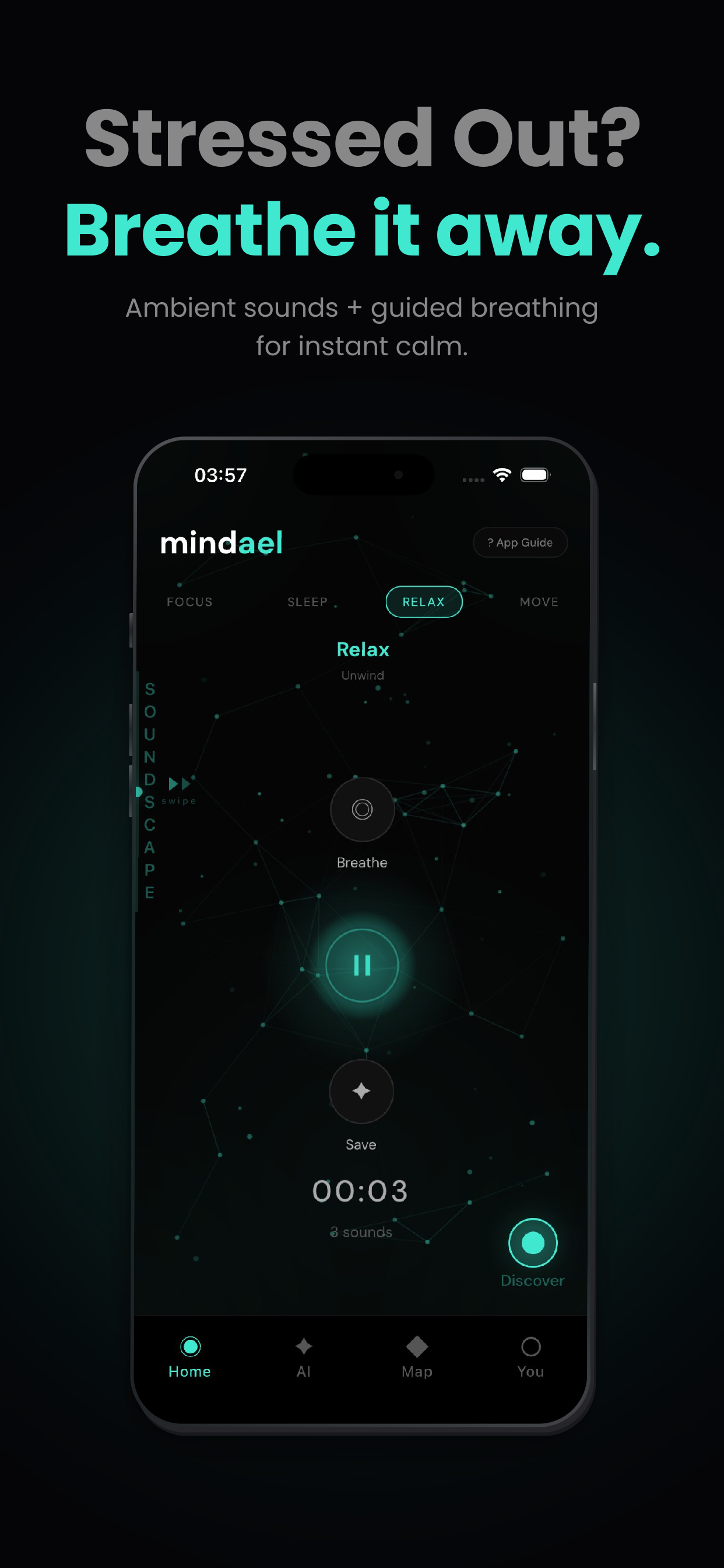
Mindael includes brown noise alongside five other noise colors: white, pink, blue, violet, and green. You can listen to any of them on their own or layer them with binaural beats, solfeggio frequencies, and over a hundred nature and ASMR sounds to build a mix that fits the moment.
In Focus mode, you can run brown noise with a Pomodoro timer for deep work sessions. In Sleep mode, you can pair it with delta beats and a sleep timer so it fades out once you have drifted off. All of it works offline, and you can start for free.
Frequently Asked Questions
Is brown noise safe to listen to all night?
Brown noise is generally safe, but most sleep experts suggest using a timer of 30 to 45 minutes rather than playing it until morning. Keep the volume at a comfortable, low level to protect your hearing.
Does brown noise actually help with ADHD?
Research on white and pink noise shows small but measurable improvements in attention for people with ADHD. Brown noise has less direct research behind it, but many people with ADHD report that its deep, steady quality helps them focus. It is worth trying for yourself.
What is the difference between brown noise and white noise?
White noise spreads energy evenly across all frequencies and sounds like static. Brown noise concentrates energy in the lower frequencies and sounds like a deep waterfall or distant thunder. Most people find brown noise warmer and more comfortable for long listening sessions.
Can I mix brown noise with other sounds?
Yes. Many people combine brown noise with nature sounds like rain or ocean waves, or layer it with binaural beats for a more targeted effect. Sound mixing apps like Mindael let you blend multiple sounds and adjust each one separately.
