Search for binaural beats on TikTok or YouTube and you will find millions of videos promising sharper focus, deeper sleep, less anxiety, and almost everything in between. Wellness creators stack them with meditation playlists. Students loop them through study sessions. Parents put them on for restless toddlers. The whole genre has quietly become one of the most popular forms of audio self help on the internet.
But what is actually happening when you press play, and does the science back up the claims? In this article we will look at how binaural beats work, the brainwave frequencies behind them, what researchers have learned about their effects on sleep, focus, and anxiety, and how to get something useful out of them in everyday life.
What Are Binaural Beats?
A binaural beat is not really a sound. It is something your brain assembles. When your left ear hears a steady tone at one frequency and your right ear hears another tone at a slightly different frequency, your auditory system tries to reconcile the difference. The result is the perception of a third, slower tone that does not exist in either signal on its own.
For example, if you play a 200 Hz tone in your left ear and a 210 Hz tone in your right ear, your brain perceives a 10 Hz beat. That 10 Hz pulse is the binaural beat. It only shows up when the two original tones are heard separately, which is why headphones or earbuds are not optional. A regular speaker mixes the two channels in the air, and the effect disappears.

The interesting part is what happens next. Researchers have observed that when the brain perceives a binaural beat at a specific frequency, brainwave activity tends to drift toward that same frequency. This is called the frequency following response, and it is the foundation of what people mean when they talk about brainwave entrainment. The idea is simple: feed your brain a 10 Hz beat for a while and the brain might settle into a 10 Hz alpha state. Calmer, more relaxed, less reactive.
How strong this effect actually is depends on the person, the frequency, and the situation. We will get into the research in a bit. But the underlying mechanism is real, and it is what makes binaural beats different from background noise like brown or pink noise, which work mostly through masking rather than direct neural influence.
The Five Brainwave Frequencies
To understand which binaural beat to choose, it helps to know the five brainwave bands the human brain cycles through every day. Each one is tied to a different mental state, and each one matches a different range of binaural beat frequencies.

- Delta (1-4 Hz). The slowest waves, dominant during deep, restorative sleep. Binaural beats in this range are usually paired with sleep audio.
- Theta (4-8 Hz). The state you slip into during light sleep, deep meditation, and creative daydreaming.
- Alpha (8-13 Hz). Calm, relaxed, eyes closed, awake. The state most people reach for when they want to take the edge off without falling asleep.
- Beta (13-30 Hz). Alert, focused, actively thinking. The everyday working brain.
- Gamma (30-50 Hz). Fast, high frequency activity tied to memory, learning, and problem solving.
You do not need to memorize the exact numbers. The simple version: the slower the beat, the more relaxed the target state. The faster the beat, the more activated.
Binaural Beats for Sleep
Sleep is one of the most popular use cases, and probably the one with the most consistent research behind it. The logic is straightforward. Delta waves dominate during deep sleep, so a delta range binaural beat (somewhere between 1 and 4 Hz) is meant to nudge a tired but restless brain in that direction.
One often cited study followed elite soccer players who listened to a 3 Hz binaural beat layered on top of a low carrier tone before bed. Over the course of several weeks, the players reported better sleep quality and lower fatigue scores than a control group. The Sleep Foundation has a good summary of similar studies, most of which point in the same direction. The effects are not dramatic, but they are real and consistent enough to take seriously.
Theta range beats (around 6 Hz) are sometimes used during the wind down period before bed rather than during sleep itself. The goal there is not to put you under, but to slow your thoughts down enough that falling asleep becomes easier.
A few practical notes if you want to try this. Start the audio fifteen to thirty minutes before you actually want to be asleep. Keep the volume low, just loud enough to hear comfortably with earbuds or a headband designed for sleep. And give it more than one night. Sleep responds to routines, not single sessions.
Binaural Beats for Focus and Concentration
For focus, the target shifts to the higher end of the spectrum. Beta beats (13 to 30 Hz) line up with the alert, engaged state most people want when they are working, studying, or coding. Gamma beats go a step further and are sometimes used for tasks that need fast recall or complex reasoning.
Some of the most interesting recent work in this area has come out of the partnership between Brain.fm and researchers at Northeastern University. Their 2025 study tested rhythmic audio similar to binaural beats with adults who had ADHD symptoms, and found measurable improvements in sustained attention compared to silence and ordinary music. It is the kind of result that does not promise a cure but does suggest a real, useful effect for the right person.
There is also a growing body of work on alpha range beats and stress. A 2025 study published in Cureus found that short alpha sessions before high pressure tasks reduced reported stress and improved task performance, which fits the broader pattern: slower beats calm, faster beats activate.
If you want to try this for work, start a few minutes before you actually need to focus. Twenty to thirty minutes is plenty. You can layer a beta beat over brown noise or rain so it does not feel like a clinical tone in your ear, which most people find more enjoyable for long sessions.
Binaural Beats for Anxiety
Anxiety is the area where binaural beats have probably been studied the most rigorously. Several hospital based trials have tested whether listening to alpha or theta beats before a stressful procedure can reduce pre operative anxiety. The answer, in study after study, is yes, modestly but reliably.
One of the larger trials followed 291 patients in an emergency department setting and found that those who listened to binaural beats during their wait reported significantly less anxiety than the control group. Other surgical and dental studies have reported similar findings. The effect sizes are not huge, but they are consistent enough that some clinicians have started using binaural audio as a low cost addition to standard care.
For everyday anxiety, the protocol most people land on is simple. Put on a theta or alpha session for fifteen to twenty minutes, sit somewhere quiet, close your eyes, and let your breath slow down on its own. It is not a replacement for therapy or medication if you need those things, but as a daily reset it is hard to beat for the price of a free app.
Do Binaural Beats Actually Work? What the Research Shows
Here is the honest version. Binaural beats are real and the frequency following response is a real phenomenon. But the gap between "real effect" and "miracle tool" is wide, and most of the science still sits closer to the first than the second.
The studies that exist are often small, short, and run in lab conditions that do not look much like normal life. Sample sizes of twenty or thirty are common. Meta analyses, including recent reviews of auditory stimulation in attention research, tend to find small but real effects, with a lot of variation between people. Some studies show no effect at all. A few show effects bigger than expected. None of them prove that binaural beats are a substitute for sleep, therapy, or medication.
Two things matter when reading the research. First, placebo effects are part of the picture. If you sit down, put on headphones, and tell yourself this is going to help you relax, you will probably relax to some degree. That is not a problem, it is just worth knowing. Second, individual response varies a lot. Some people feel a clear shift after their first session. Others feel nothing after weeks of daily use. The only way to know which group you are in is to try.
The good news is that binaural beats appear to be safe for healthy adults. There is no known harm from regular listening at sensible volumes. People with epilepsy should check with a doctor first, since rhythmic auditory stimulation can, very rarely, trigger seizures.
How to Use Binaural Beats Effectively
If you want to actually get something out of binaural beats rather than just adding another tab to the pile, a few simple habits will get you there.
- Use stereo headphones or earbuds. No exceptions. Speakers do not produce the effect.
- Pick a frequency that matches your goal. Delta for sleep, theta for meditation, alpha for calm focus, beta for active work, gamma for hard problem solving.
- Start with sessions of fifteen to thirty minutes. Longer is not better and can leave you feeling worn out.
- Keep the volume low. The beat should sit in the background, not dominate your attention.
- Layer it with something pleasant. Rain, ocean, brown noise, or soft ambient pads make long sessions much easier on the ears than a raw test tone.
- Be consistent. Like meditation or exercise, the effect builds when you use it daily for a couple of weeks rather than once and forgetting about it.
Treat them like a tool, not a magic switch. Pair them with the basics that are known to work, like real sleep, real breaks, and real movement, and they become a useful little nudge. On their own they will not change your life.
Try Binaural Beats in Mindael
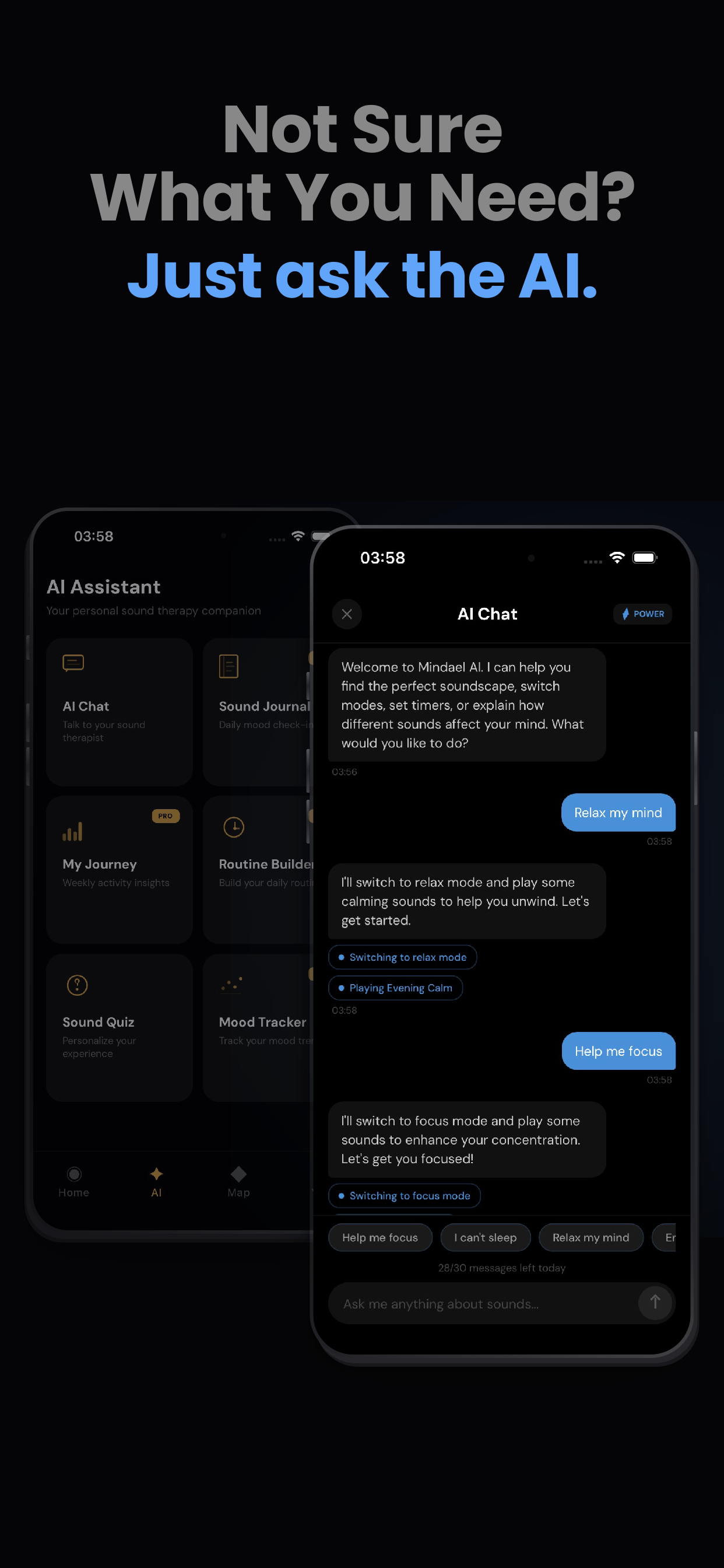
Mindael includes the full range of binaural beat frequencies from delta through gamma. You can listen to a beat on its own or layer it with brown noise, nature sounds, or solfeggio frequencies to build a mix that fits the moment.
In Focus mode, you can stack a beta beat with a Pomodoro timer and a background of rain or brown noise for a deep work session. In Sleep mode, a delta beat with a sleep timer fades out once you have drifted off so it does not run all night. The built in AI assistant can suggest a frequency and a mix based on what you are trying to do, which makes it easier to get started without guessing.
You can try it for free. If you want the full library of beats and the AI features, the Premium plan opens everything up.
Frequently Asked Questions
Do I need headphones for binaural beats?
Yes. Binaural beats only work when each ear receives a different frequency, so stereo headphones or earbuds are required.
How long should I listen to binaural beats?
Most studies use sessions of 15 to 30 minutes. Longer is not necessarily better. Start with shorter sessions and see how you respond.
Can binaural beats be harmful?
There is no evidence that binaural beats cause harm in healthy adults. However, people with epilepsy should consult a doctor first, as rhythmic auditory stimulation could theoretically trigger seizures in rare cases.
Which frequency should I choose?
It depends on your goal. Delta (1-4 Hz) for deep sleep, theta (4-8 Hz) for meditation and relaxation, alpha (8-13 Hz) for calm focus, beta (13-30 Hz) for active concentration, and gamma (30+ Hz) for memory and problem solving.
